About the Report
Base Year 2024Thailand Virtual Visits Market Overview
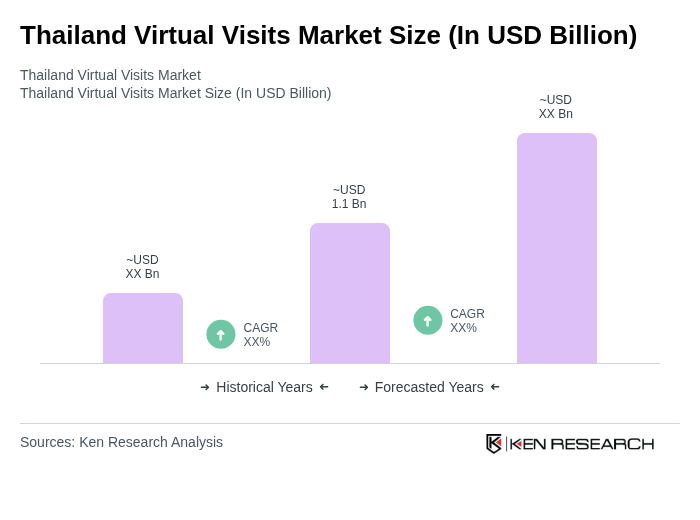
- The Thailand Virtual Visits Market is valued at USD 1.1 billion, based on a five-year historical analysis, aligning with the current revenue scale of the national telehealth market and the share attributable to real-time virtual consultations within broader telehealth services. This growth is primarily driven by the increasing adoption of telehealth services, accelerated by the COVID-19 pandemic, which led to a surge in demand for remote healthcare solutions, and by the continued expansion of internet and smartphone penetration across Thailand. The market is further supported by advancements in video consultation platforms, remote monitoring technologies, and a growing acceptance of virtual consultations among patients and healthcare providers, particularly for follow?up care and chronic disease management.
- Key cities such as Bangkok, Chiang Mai, and Phuket dominate the market due to their robust healthcare infrastructure, higher specialist concentration, and high population density, which support faster adoption of digital health solutions. Bangkok, as the capital, serves as a hub for healthcare innovation and technology, hosting major private hospital groups and leading telehealth platforms, while Chiang Mai and Phuket attract both local and international patients seeking quality healthcare services and are key destinations for medical tourism, thus enhancing the market's growth potential.
- In 2023, the Thai government strengthened the regulatory framework promoting telemedicine through measures under the Notification of the Medical Council on Telemedicine B.E. 2564 (2021), issued by the Medical Council of Thailand, and related guidelines of the Ministry of Public Health, which set conditions for licensed Thai physicians to provide remote consultations, including identity verification, proper medical record keeping, and use of secure communication technologies. These instruments allow healthcare providers to offer virtual consultations without requiring an initial in?person visit in many cases, while ensuring that practitioners hold a local medical license and comply with professional standards. This policy direction aims to improve access to healthcare services, especially in rural and underserved areas, reduce the burden on large urban hospitals, and forms part of a broader national strategy to enhance the efficiency and digital transformation of the healthcare system in Thailand.
Thailand Virtual Visits Market Segmentation
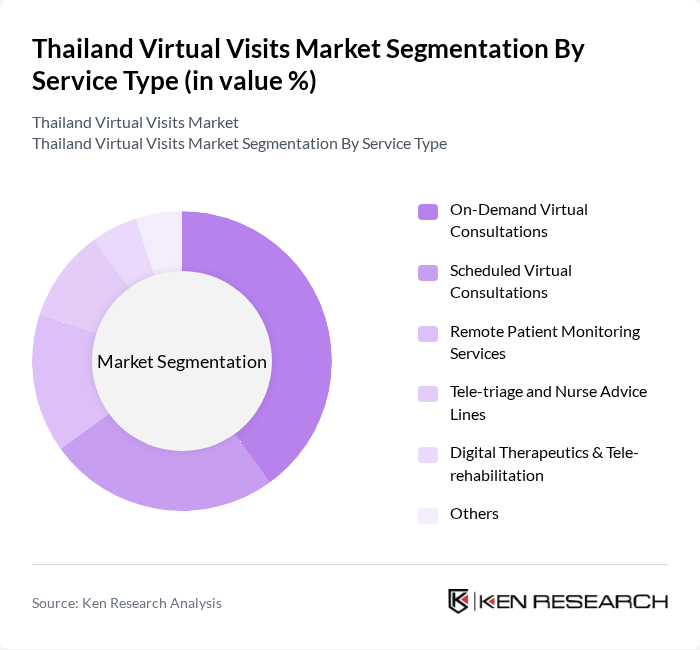
By Service Type:The service type segmentation includes various offerings that cater to different patient needs. The subsegments are On-Demand Virtual Consultations, Scheduled Virtual Consultations, Remote Patient Monitoring Services, Tele-triage and Nurse Advice Lines, Digital Therapeutics & Tele-rehabilitation, and Others. Among these, On-Demand Virtual Consultations are leading the market due to their convenience and immediate access to healthcare professionals, which aligns with the growing consumer preference for quick and efficient healthcare solutions and the dominance of real-time patient interactions within Thailand’s telehealth services mix.
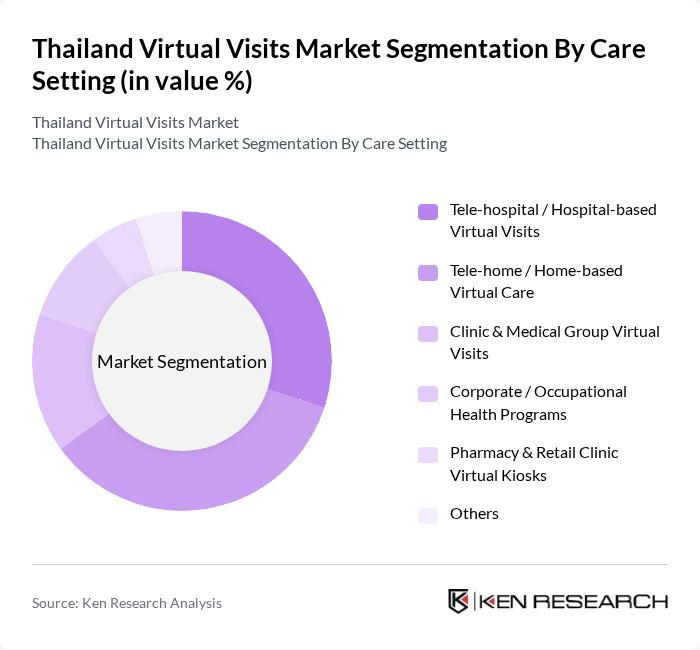
By Care Setting:This segmentation focuses on the environments where virtual visits are conducted, including Tele-hospital / Hospital-based Virtual Visits, Tele-home / Home-based Virtual Care, Clinic & Medical Group Virtual Visits, Corporate / Occupational Health Programs, Pharmacy & Retail Clinic Virtual Kiosks, and Others. Tele-home / Home-based Virtual Care is currently the dominant segment, driven by the increasing preference for at-home healthcare solutions, particularly for online doctor consultations and chronic disease management, as well as by the wider use of smartphones, home internet, and connected devices that enable patients to interact with clinicians from their homes.
Thailand Virtual Visits Market Competitive Landscape
The Thailand Virtual Visits Market is characterized by a dynamic mix of regional and international players. Leading participants such as Bangkok Hospital (BDMS Network), Bumrungrad International Hospital, Samitivej Hospital (Samitivej Group), Thonburi Healthcare Group (THG), Vejthani Hospital, Phyathai Hospital (Phyathai – Paolo Network), Bangkok Dusit Medical Services (BDMS), King Chulalongkorn Memorial Hospital (Thai Red Cross), Siriraj Hospital (Mahidol University), MedPark Hospital, Krungthep General Hospital, Piyavate Hospital, Bangkok Christian Hospital, Samitivej Sriracha Hospital, BNH Hospital contribute to innovation, geographic expansion, and service delivery in this space.
Thailand Virtual Visits Market Industry Analysis
Growth Drivers
- Increased Internet Penetration:Thailand's internet penetration rate reached 82% in future, with approximately 57 million users accessing online services. This growth is supported by the government's investment of over THB 20 billion in digital infrastructure, aiming to enhance connectivity in rural areas. As more individuals gain access to the internet, the potential for virtual healthcare services expands, enabling healthcare providers to reach a broader audience and improve patient engagement significantly.
- Rising Demand for Remote Healthcare Services:The COVID-19 pandemic accelerated the demand for remote healthcare, with telehealth consultations increasing by 300% in future. Approximately 40% of patients reported a preference for virtual visits over in-person appointments due to convenience and safety. This shift is further supported by Thailand's aging population, projected to reach 20% in future, necessitating accessible healthcare solutions that virtual visits can provide effectively.
- Technological Advancements in Virtual Communication:The Thai government has allocated THB 15 billion for the development of digital health technologies, fostering innovations in virtual communication. The integration of AI and machine learning in healthcare applications is expected to enhance diagnostic accuracy and patient monitoring. With over 70% of healthcare providers adopting telemedicine platforms, these advancements are crucial in improving the efficiency and effectiveness of virtual visits in Thailand.
Market Challenges
- Data Privacy Concerns:Data privacy remains a significant challenge in Thailand's virtual visits market, with 60% of consumers expressing concerns about the security of their health information. The lack of robust data protection laws has led to increased scrutiny from both consumers and regulatory bodies. As the market grows, addressing these concerns will be essential to build trust and encourage wider adoption of virtual healthcare services.
- Limited Digital Literacy in Certain Demographics:Despite high internet penetration, approximately 30% of the Thai population lacks the digital literacy required to navigate virtual healthcare platforms effectively. This gap is particularly pronounced among older adults and rural residents. To maximize the potential of virtual visits, targeted educational initiatives are necessary to empower these demographics and ensure equitable access to healthcare services.
Thailand Virtual Visits Market Future Outlook
The future of Thailand's virtual visits market appears promising, driven by ongoing technological advancements and increasing consumer acceptance. As healthcare providers continue to innovate and enhance their digital offerings, the integration of AI and mobile health applications will likely become more prevalent. Additionally, the shift towards patient-centric care models will further encourage the adoption of virtual visits, ensuring that healthcare services remain accessible and efficient for all segments of the population.
Market Opportunities
- Expansion of Telehealth Services:The Thai government aims to increase telehealth service availability by 50% in future, creating significant opportunities for healthcare providers. This expansion will facilitate better access to healthcare, particularly in underserved areas, and improve overall health outcomes for the population.
- Integration with Wearable Health Technologies:The wearable health technology market in Thailand is projected to grow to THB 10 billion in future. Integrating these devices with virtual visits can enhance patient monitoring and engagement, providing healthcare providers with real-time data to improve treatment plans and patient outcomes.
Scope of the Report
| Segment | Sub-Segments |
|---|---|
| By Service Type | On Demand Virtual Consultations Scheduled Virtual Consultations Remote Patient Monitoring Services Tele triage and Nurse Advice Lines Digital Therapeutics & Tele rehabilitation Others |
| By Care Setting | Tele hospital / Hospital based Virtual Visits Tele home / Home based Virtual Care Clinic & Medical Group Virtual Visits Corporate / Occupational Health Programs Pharmacy & Retail Clinic Virtual Kiosks Others |
| By Patient Profile | Acute & Episodic Care Patients Chronic Disease Patients Mental & Behavioral Health Patients Preventive & Wellness Users Pediatric Patients Geriatric Patients Others |
| By Clinical Application | Primary & Family Care Mental and Behavioral Health Chronic Disease Management Post operative & Follow up Care Emergency & Urgent Virtual Care Specialist Consultations Others |
| By Technology & Platform | Video based Teleconsultation Platforms Audio / Phone based Consultations Chat & Asynchronous Messaging Platforms Mobile Health (mHealth) Applications Web based Portals & Integrated HIS/EMR Platforms AI enabled & Automated Virtual Assistants Others |
| By Payer & Payment Model | Out of Pocket / Self Pay Public Insurance & Universal Coverage Schemes Private Health Insurance Reimbursement Employer Sponsored Plans Subscription & Membership based Models Others |
| By Geographic Coverage | Bangkok Metropolitan Region Central Thailand Northern Thailand Northeastern (Isan) Thailand Southern Thailand Cross border / International Virtual Services Others |
Key Target Audience
Investors and Venture Capitalist Firms
Government and Regulatory Bodies (e.g., Ministry of Digital Economy and Society, National Broadcasting and Telecommunications Commission)
Healthcare Providers and Telemedicine Platforms
Tourism and Hospitality Industry Stakeholders
Real Estate Developers and Property Management Firms
Event Organizers and Conference Planners
Telecommunications Companies
Insurance Companies and Health Insurers
Players Mentioned in the Report:
Bangkok Hospital (BDMS Network)
Bumrungrad International Hospital
Samitivej Hospital (Samitivej Group)
Thonburi Healthcare Group (THG)
Vejthani Hospital
Phyathai Hospital (Phyathai Paolo Network)
Bangkok Dusit Medical Services (BDMS)
King Chulalongkorn Memorial Hospital (Thai Red Cross)
Siriraj Hospital (Mahidol University)
MedPark Hospital
Krungthep General Hospital
Piyavate Hospital
Bangkok Christian Hospital
Samitivej Sriracha Hospital
BNH Hospital
Table of Contents
Market Assessment Phase
1. Executive Summary and Approach
2. Thailand Virtual Visits Market Overview
2.1 Key Insights and Strategic Recommendations
2.2 Thailand Virtual Visits Market Overview
2.3 Definition and Scope
2.4 Evolution of Market Ecosystem
2.5 Timeline of Key Regulatory Milestones
2.6 Value Chain & Stakeholder Mapping
2.7 Business Cycle Analysis
2.8 Policy & Incentive Landscape
3. Thailand Virtual Visits Market Analysis
3.1 Growth Drivers
3.1.1 Increased Internet Penetration
3.1.2 Rising Demand for Remote Healthcare Services
3.1.3 Technological Advancements in Virtual Communication
3.1.4 Government Initiatives Supporting Digital Health
3.2 Market Challenges
3.2.1 Data Privacy Concerns
3.2.2 Limited Digital Literacy in Certain Demographics
3.2.3 Regulatory Hurdles
3.2.4 Competition from Traditional Healthcare Services
3.3 Market Opportunities
3.3.1 Expansion of Telehealth Services
3.3.2 Integration with Wearable Health Technologies
3.3.3 Partnerships with Local Healthcare Providers
3.3.4 Development of Customized Virtual Care Solutions
3.4 Market Trends
3.4.1 Increased Adoption of AI in Virtual Visits
3.4.2 Growth of Mobile Health Applications
3.4.3 Shift Towards Patient-Centric Care Models
3.4.4 Rise of Hybrid Healthcare Models
3.5 Government Regulation
3.5.1 Telemedicine Licensing Requirements
3.5.2 Data Protection Regulations
3.5.3 Reimbursement Policies for Virtual Visits
3.5.4 Standards for Virtual Care Quality
4. SWOT Analysis
5. Stakeholder Analysis
6. Porter's Five Forces Analysis
7. Thailand Virtual Visits Market Market Size, 2019-2024
7.1 By Value
7.2 By Volume
7.3 By Average Selling Price
8. Thailand Virtual Visits Market Segmentation
8.1 By Service Type
8.1.1 On?Demand Virtual Consultations
8.1.2 Scheduled Virtual Consultations
8.1.3 Remote Patient Monitoring Services
8.1.4 Tele?triage and Nurse Advice Lines
8.1.5 Digital Therapeutics & Tele?rehabilitation
8.1.6 Others
8.2 By Care Setting
8.2.1 Tele?hospital / Hospital?based Virtual Visits
8.2.2 Tele?home / Home?based Virtual Care
8.2.3 Clinic & Medical Group Virtual Visits
8.2.4 Corporate / Occupational Health Programs
8.2.5 Pharmacy & Retail Clinic Virtual Kiosks
8.2.6 Others
8.3 By Patient Profile
8.3.1 Acute & Episodic Care Patients
8.3.2 Chronic Disease Patients
8.3.3 Mental & Behavioral Health Patients
8.3.4 Preventive & Wellness Users
8.3.5 Pediatric Patients
8.3.6 Geriatric Patients
8.3.7 Others
8.4 By Clinical Application
8.4.1 Primary & Family Care
8.4.2 Mental and Behavioral Health
8.4.3 Chronic Disease Management (Diabetes, CVD, COPD, etc.)
8.4.4 Post?operative & Follow?up Care
8.4.5 Emergency & Urgent Virtual Care
8.4.6 Specialist Consultations (Dermatology, Cardiology, etc.)
8.4.7 Others
8.5 By Technology & Platform
8.5.1 Video?based Teleconsultation Platforms
8.5.2 Audio / Phone?based Consultations
8.5.3 Chat & Asynchronous Messaging Platforms
8.5.4 Mobile Health (mHealth) Applications
8.5.5 Web?based Portals & Integrated HIS/EMR Platforms
8.5.6 AI?enabled & Automated Virtual Assistants
8.5.7 Others
8.6 By Payer & Payment Model
8.6.1 Out?of?Pocket / Self?Pay
8.6.2 Public Insurance & Universal Coverage Schemes
8.6.3 Private Health Insurance Reimbursement
8.6.4 Employer?Sponsored Plans
8.6.5 Subscription & Membership?based Models
8.6.6 Others
8.7 By Geographic Coverage
8.7.1 Bangkok Metropolitan Region
8.7.2 Central Thailand (ex?Bangkok)
8.7.3 Northern Thailand
8.7.4 Northeastern (Isan) Thailand
8.7.5 Southern Thailand
8.7.6 Cross?border / International Virtual Services
8.7.7 Others
9. Thailand Virtual Visits Market Competitive Analysis
9.1 Market Share of Key Players
9.2 Cross Comparison of Key Players
9.2.1 Company Name
9.2.2 Group Size (Large, Medium, or Small as per industry convention)
9.2.3 Customer Acquisition Cost (CAC) per Paying User
9.2.4 Monthly Active Users (MAUs)
9.2.5 Number of Virtual Visits Conducted per Year
9.2.6 Average Revenue Per User (ARPU)
9.2.7 Annual Recurring Revenue (ARR) from Virtual Visits
9.2.8 Virtual Visit Gross Margin (%)
9.2.9 Customer Retention / Churn Rate
9.2.10 Average Ticket Size per Virtual Visit
9.2.11 Market Penetration Rate (Share of Addressable Population)
9.2.12 Average Waiting Time to First Available Slot
9.2.13 First?Contact Resolution Rate
9.2.14 Net Promoter Score (NPS) / User Satisfaction Score
9.2.15 Technology & Automation Level (Share of AI?enabled Interactions)
9.3 SWOT Analysis of Top Players
9.4 Pricing Analysis
9.5 Detailed Profile of Major Companies
9.5.1 Bangkok Hospital (BDMS Network)
9.5.2 Bumrungrad International Hospital
9.5.3 Samitivej Hospital (Samitivej Group)
9.5.4 Thonburi Healthcare Group (THG)
9.5.5 Vejthani Hospital
9.5.6 Phyathai Hospital (Phyathai – Paolo Network)
9.5.7 Bangkok Dusit Medical Services (BDMS)
9.5.8 King Chulalongkorn Memorial Hospital (Thai Red Cross)
9.5.9 Siriraj Hospital (Mahidol University)
9.5.10 MedPark Hospital
9.5.11 Krungthep General Hospital
9.5.12 Piyavate Hospital
9.5.13 Bangkok Christian Hospital
9.5.14 Samitivej Sriracha Hospital
9.5.15 BNH Hospital
10. Thailand Virtual Visits Market End-User Analysis
10.1 Procurement Behavior of Key Ministries
10.1.1 Ministry of Public Health
10.1.2 Ministry of Digital Economy and Society
10.1.3 Ministry of Education
10.1.4 Others
10.2 Corporate Spend on Infrastructure & Energy
10.2.1 Healthcare Infrastructure Investments
10.2.2 Technology Upgrades
10.2.3 Training and Development
10.2.4 Others
10.3 Pain Point Analysis by End-User Category
10.3.1 Patients
10.3.2 Healthcare Providers
10.3.3 Insurance Companies
10.3.4 Others
10.4 User Readiness for Adoption
10.4.1 Awareness Levels
10.4.2 Technological Proficiency
10.4.3 Trust in Virtual Care
10.4.4 Others
10.5 Post-Deployment ROI and Use Case Expansion
10.5.1 Cost Savings
10.5.2 Improved Patient Outcomes
10.5.3 Scalability of Services
10.5.4 Others
11. Thailand Virtual Visits Market Future Size, 2025-2030
11.1 By Value
11.2 By Volume
11.3 By Average Selling Price
Go-To-Market Strategy Phase
1. Whitespace Analysis + Business Model Canvas
1.1 Market Gaps Identification
1.2 Business Model Development
2. Marketing and Positioning Recommendations
2.1 Branding Strategies
2.2 Product USPs
3. Distribution Plan
3.1 Urban Retail vs Rural NGO Tie-Ups
4. Channel & Pricing Gaps
4.1 Underserved Routes
4.2 Pricing Bands
5. Unmet Demand & Latent Needs
5.1 Category Gaps
5.2 Consumer Segments
6. Customer Relationship
6.1 Loyalty Programs
6.2 After-Sales Service
7. Value Proposition
7.1 Sustainability
7.2 Integrated Supply Chains
8. Key Activities
8.1 Regulatory Compliance
8.2 Branding
8.3 Distribution Setup
9. Entry Strategy Evaluation
9.1 Domestic Market Entry Strategy
9.1.1 Product Mix
9.1.2 Pricing Band
9.1.3 Packaging
9.2 Export Entry Strategy
9.2.1 Target Countries
9.2.2 Compliance Roadmap
10. Entry Mode Assessment
10.1 JV
10.2 Greenfield
10.3 M&A
10.4 Distributor Model
11. Capital and Timeline Estimation
11.1 Capital Requirements
11.2 Timelines
12. Control vs Risk Trade-Off
12.1 Ownership vs Partnerships
13. Profitability Outlook
13.1 Breakeven Analysis
13.2 Long-Term Sustainability
14. Potential Partner List
14.1 Distributors
14.2 JVs
14.3 Acquisition Targets
15. Execution Roadmap
15.1 Phased Plan for Market Entry
15.1.1 Market Setup
15.1.2 Market Entry
15.1.3 Growth Acceleration
15.1.4 Scale & Stabilize
15.2 Key Activities and Milestones
15.2.1 Milestone Planning
15.2.2 Activity Tracking
Research Methodology
Phase 1: Approach1
Desk Research
- Analysis of government reports on tourism and virtual experiences in Thailand
- Review of industry publications and market analysis reports on virtual visits
- Examination of online platforms and technology providers in the virtual tourism space
Primary Research
- Interviews with key stakeholders in the tourism sector, including tour operators and travel agencies
- Surveys targeting consumers who have participated in virtual visits to gather insights on preferences and experiences
- Focus group discussions with technology providers to understand the capabilities and trends in virtual visit offerings
Validation & Triangulation
- Cross-validation of findings through comparison with existing market data and trends
- Triangulation of insights from primary interviews with secondary research findings
- Sanity checks conducted through expert panel reviews to ensure data reliability
Phase 2: Market Size Estimation1
Top-down Assessment
- Estimation of market size based on overall tourism revenue and the share attributed to virtual experiences
- Segmentation of the market by type of virtual visit (e.g., cultural, adventure, educational)
- Incorporation of growth rates from related sectors such as digital content and online travel services
Bottom-up Modeling
- Collection of data on the number of virtual visits offered by key players in the market
- Analysis of pricing models and revenue generated per virtual visit
- Estimation of user engagement metrics to project potential market growth
Forecasting & Scenario Analysis
- Development of forecasts based on historical growth trends and emerging consumer behaviors
- Scenario analysis considering factors such as technological advancements and shifts in travel preferences
- Creation of multiple projections (baseline, optimistic, and pessimistic) through 2030
Phase 3: CATI Sample Composition1
| Scope Item/Segment | Sample Size | Target Respondent Profiles |
|---|---|---|
| Virtual Cultural Tours | 100 | Tour Operators, Cultural Institutions |
| Virtual Adventure Experiences | 80 | Adventure Travel Companies, Experience Designers |
| Educational Virtual Visits | 70 | Educational Institutions, Curriculum Developers |
| Consumer Feedback on Virtual Visits | 120 | Recent Participants, Travel Enthusiasts |
| Technology Providers in Virtual Tourism | 60 | Tech Developers, Product Managers |
Frequently Asked Questions
What is the current value of the Thailand Virtual Visits Market?
The Thailand Virtual Visits Market is valued at approximately USD 1.1 billion, reflecting the growth in telehealth services, particularly real-time virtual consultations, which have gained traction due to increased internet access and the COVID-19 pandemic.
What factors are driving the growth of virtual visits in Thailand?
Which cities in Thailand are leading in virtual visits adoption?
How has the Thai government supported telemedicine?
Other Regional/Country Reports
Other Adjacent Reports
Bahrain Wearable Health Technology Market
KSA Mobile Health Market
KSA healthcare it market size, share, growth drivers, trends, opportunities & forecast 2025–2030Philippines Medical Tourism Market Size, Share & Forecast, By Service Type, Care Setting & Customer Type, 2026–2032Middle East Chronic Disease Management Market Size, Share, Growth Drivers, Trends, Opportunities & Forecast 2025–2030GCC AI in Healthcare Market Size, Share & Forecast, By Solution Type, Application & Care Setting, 2026-2031Australia Cybersecurity in Healthcare MarketWhy Buy From Us?

What makes us stand out is that our consultants follow Robust, Refine and Result (RRR) methodology. Robust for clear definitions, approaches and sanity checking, Refine for differentiating respondents' facts and opinions, and Result for presenting data with story.

We have set a benchmark in the industry by offering our clients with syndicated and customized market research reports featuring coverage of entire market as well as meticulous research and analyst insights.

While we don't replace traditional research, we flip the method upside down. Our dual approach of Top Bottom & Bottom Top ensures quality deliverable by not just verifying company fundamentals but also looking at the sector and macroeconomic factors.

With one step in the future, our research team constantly tries to show you the bigger picture. We help with some of the tough questions you may encounter along the way: How is the industry positioned? Best marketing channel? KPI's of competitors? By aligning every element, we help maximize success.

Our report gives you instant access to the answers and sources that other companies might choose to hide. We elaborate each steps of research methodology we have used and showcase you the sample size to earn your trust.

If you need any support, we are here! We pride ourselves on universe strength, data quality, and quick, friendly, and professional service.