About the Report
Base Year 2024United Arab Emirates Hydrogen Storage Market Overview
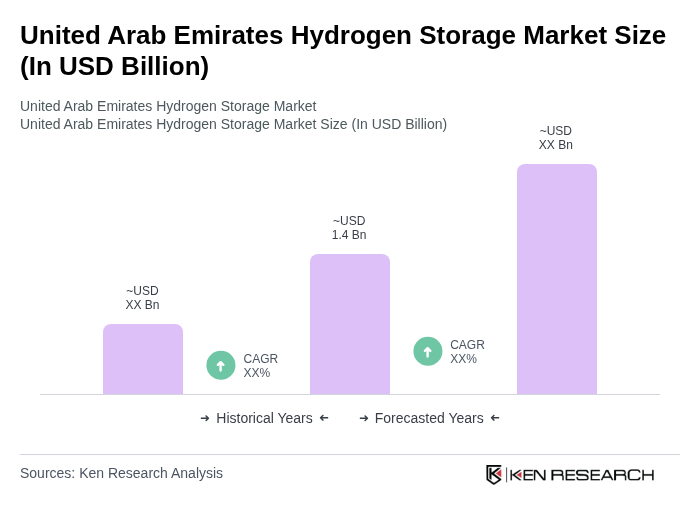
- The United Arab Emirates Hydrogen Storage Market is valued at approximately USD 1.4 billion, based on a five-year historical analysis of the broader UAE hydrogen and green hydrogen value chain, including production, storage, and associated infrastructure. This growth is primarily driven by the increasing demand for clean energy solutions, accelerated deployment of green hydrogen projects, and large-scale investments in renewable energy and hydrogen export infrastructure. The market is witnessing a surge in hydrogen production and storage technologies, including high-pressure tanks, liquid hydrogen storage, and ammonia-based carriers, which are essential for the transition to a low-carbon and export-oriented hydrogen economy.
- Key players in this market include Abu Dhabi National Oil Company (ADNOC), Emirates National Oil Company (ENOC), and international firms like Air Products and Chemicals, Inc. and Linde plc. The dominance of these companies is attributed to their extensive experience in energy production and industrial gases, strong financial backing, and strategic partnerships that enhance their capabilities in hydrogen production, storage, and distribution, including major green hydrogen and green ammonia projects in Abu Dhabi’s industrial zones and export hubs.
- In 2023, the UAE government adopted a comprehensive hydrogen roadmap under the UAE National Hydrogen Strategy 2050, positioning the country as a global hub for hydrogen production, storage, and export. This strategic framework is backed by multi?billion?dollar investments in hydrogen infrastructure and technology development, including large-scale projects at TA’ZIZ in Ruwais and Khalifa Economic Zones Abu Dhabi (KEZAD), which together represent several billion in hydrogen and green ammonia investments and focus on both green and low?carbon hydrogen projects to meet domestic industrial demand and international export markets.
United Arab Emirates Hydrogen Storage Market Segmentation
By Storage Form:The hydrogen storage market can be segmented into various forms, including compressed gaseous hydrogen, liquefied hydrogen, solid/material-based storage, liquid organic hydrogen carriers, and hydrogen derivatives. Each of these forms has unique characteristics and applications, catering to different sectors and consumer needs, with compressed and liquefied hydrogen currently most mature for mobility and industrial use, while derivatives such as ammonia and methanol are increasingly used for long-distance energy transport and export.
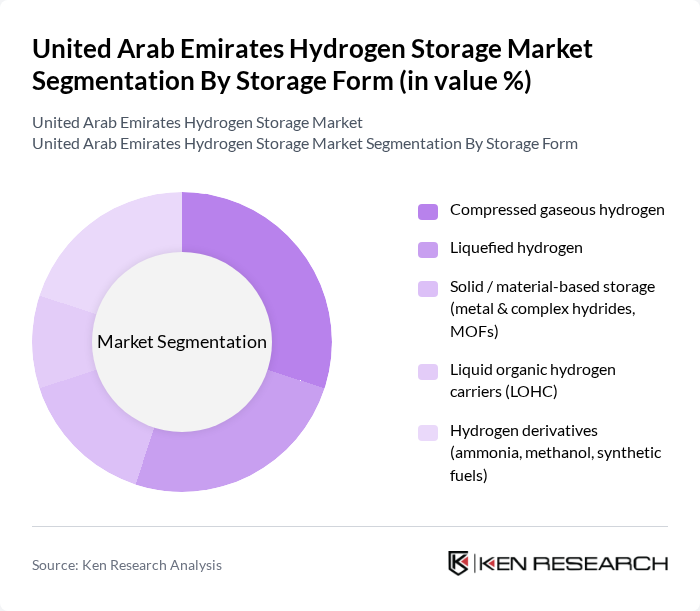
The leading subsegment in the hydrogen storage market is compressed gaseous hydrogen, which is favored for its technological maturity and suitability for refuelling infrastructure, especially in early-stage mobility and industrial applications. This form is widely used in various applications, including fuel cell vehicles, material handling equipment, and industrial processes, due to its relatively lower up?front system costs and established standards for cylinders and high?pressure systems. The growing demand for hydrogen as a clean energy source in transportation and power generation, combined with ongoing deployment of refuelling stations and industrial pilot projects in the UAE, further drives its adoption, making it a preferred choice among consumers and industries in the near to medium term.
By Storage Technology:The market can also be segmented based on storage technology, which includes physical storage, underground storage, on-board storage systems for mobility, and stationary storage systems. Each technology offers distinct advantages and is suited for specific applications in the hydrogen ecosystem, from short-term buffering at production sites and fuelling stations to potential large-scale seasonal storage in geological formations.
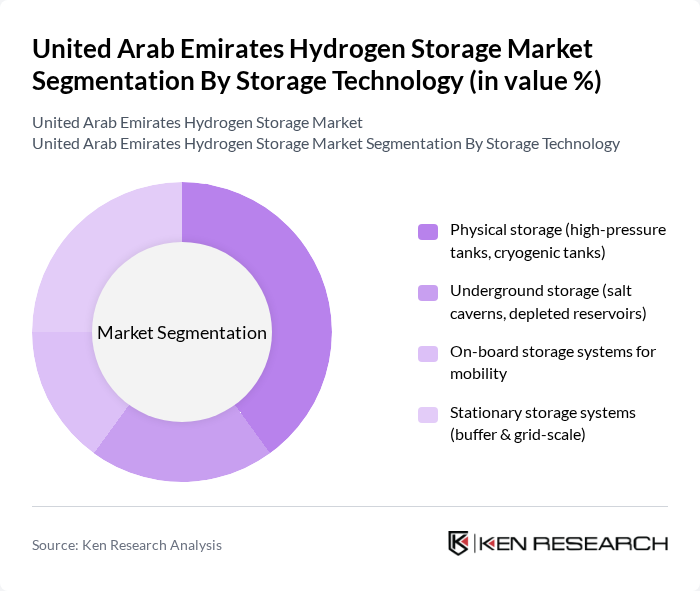
Physical storage technology, particularly high-pressure and cryogenic tanks, dominates the market due to its widespread application in refuelling infrastructure, industrial gas logistics, and early hydrogen mobility projects. The ability to store hydrogen at high pressures enables efficient transport and utilization in distributed applications, making it a critical component in the hydrogen supply chain from production sites to end users. Additionally, advancements in tank design, composite materials, and safety systems are improving energy density and operational performance, further solidifying its position as the leading storage technology in the UAE’s emerging hydrogen ecosystem.
United Arab Emirates Hydrogen Storage Market Competitive Landscape
The United Arab Emirates Hydrogen Storage Market is characterized by a dynamic mix of regional and international players. Leading participants such as Abu Dhabi National Oil Company (ADNOC), Emirates National Oil Company (ENOC), Air Products and Chemicals, Inc., Linde plc, Siemens Energy AG, Shell plc (Shell Hydrogen), Hydrogenics Corporation, Plug Power Inc., Ballard Power Systems Inc., thyssenkrupp AG, McPhy Energy S.A., Nel ASA, ITM Power plc, H2GO Power Ltd., Green Hydrogen Systems A/S contribute to innovation, geographic expansion, and service delivery in this space, leveraging their expertise in electrolysis, industrial gases, engineering, and large?scale project development to support UAE hydrogen production, storage, and export initiatives.
United Arab Emirates Hydrogen Storage Market Industry Analysis
Growth Drivers
- Increasing Demand for Renewable Energy Sources:The United Arab Emirates (UAE) is witnessing a significant shift towards renewable energy, with a target of generating 50% of its energy from clean sources by 2050. In future, the UAE aims to produce 30,000 GWh from renewable sources, driving the need for efficient hydrogen storage solutions. This transition is supported by the UAE's commitment to the Paris Agreement, which mandates a reduction in carbon emissions, further boosting hydrogen's role in the energy mix.
- Government Initiatives Promoting Hydrogen Technology:The UAE government has launched several initiatives to promote hydrogen technology, including the National Hydrogen Strategy, which aims to position the country as a global leader in hydrogen production and export. In future, the government plans to invest AED 700 million in hydrogen-related projects, enhancing research and development. This strategic focus is expected to create a robust framework for hydrogen storage, facilitating its integration into the energy landscape.
- Investments in Infrastructure for Hydrogen Storage:The UAE is actively investing in hydrogen storage infrastructure, with plans to develop facilities capable of storing over 1.5 million tons of hydrogen by 2025. This investment is part of a broader strategy to enhance energy security and support the growing hydrogen economy. In future, the UAE's investment in hydrogen infrastructure is projected to reach AED 1.2 billion, significantly improving the capacity and efficiency of hydrogen storage solutions across the region.
Market Challenges
- High Initial Investment Costs:One of the primary challenges facing the hydrogen storage market in the UAE is the high initial investment required for infrastructure development. The cost of establishing hydrogen storage facilities can exceed AED 600 million, which poses a barrier for many potential investors. This financial hurdle is compounded by the need for advanced technology and skilled labor, making it difficult for smaller companies to enter the market and compete effectively.
- Limited Public Awareness and Understanding:Despite the UAE's advancements in hydrogen technology, there remains a significant gap in public awareness and understanding of hydrogen storage benefits. In future, surveys indicate that only 35% of the population is familiar with hydrogen as a clean energy source. This lack of awareness can hinder the adoption of hydrogen technologies and slow down market growth, as public support is crucial for the successful implementation of new energy solutions.
United Arab Emirates Hydrogen Storage Market Future Outlook
The future of the hydrogen storage market in the UAE appears promising, driven by increasing investments and technological advancements. As the government continues to prioritize hydrogen as a key component of its energy strategy, the market is expected to see enhanced collaboration between public and private sectors. Additionally, the integration of hydrogen storage with renewable energy sources will likely lead to more efficient energy systems, positioning the UAE as a leader in sustainable energy solutions in future.
Market Opportunities
- Expansion of Hydrogen Infrastructure:The ongoing expansion of hydrogen infrastructure presents a significant opportunity for market players. With the UAE's commitment to developing a comprehensive hydrogen network, companies can capitalize on this growth by investing in storage technologies and facilities, potentially increasing their market share and profitability.
- Collaborations with International Hydrogen Projects:Engaging in collaborations with international hydrogen projects can provide UAE companies access to advanced technologies and best practices. Such partnerships can enhance local expertise and facilitate knowledge transfer, ultimately leading to more innovative and efficient hydrogen storage solutions in the region.
Scope of the Report
| Segment | Sub-Segments |
|---|---|
| By Storage Form | Compressed gaseous hydrogen Liquefied hydrogen Solid / material-based storage (metal & complex hydrides, MOFs) Liquid organic hydrogen carriers (LOHC) Hydrogen derivatives (ammonia, methanol, synthetic fuels) |
| By Storage Technology | Physical storage (high-pressure tanks, cryogenic tanks) Underground storage (salt caverns, depleted reservoirs) On-board storage systems for mobility Stationary storage systems (buffer & grid-scale) |
| By Application | Power generation & grid balancing Industrial feedstock & process use Mobility and transport (road, marine, aviation) Export & bunkering hubs Residential & commercial energy storage |
| By End-User Sector | Oil & gas and refining Power & utilities Chemicals, steel & heavy industry Transport & logistics operators Government & public sector projects Others |
| By Project Type | Green hydrogen storage projects Blue hydrogen storage projects Grey / brown hydrogen storage (transition assets) |
| By Ownership Model | National oil companies & state-owned enterprises Independent power producers & project developers Industrial offtakers (captive storage) Joint ventures & consortia |
Key Target Audience
Investors and Venture Capitalist Firms
Government and Regulatory Bodies (e.g., Ministry of Energy and Infrastructure, Abu Dhabi Department of Energy)
Manufacturers and Producers of Hydrogen Storage Solutions
Energy Sector Stakeholders
Infrastructure Development Agencies
Oil and Gas Companies
Environmental and Sustainability Organizations
Utility Companies and Energy Providers
Players Mentioned in the Report:
Abu Dhabi National Oil Company (ADNOC)
Emirates National Oil Company (ENOC)
Air Products and Chemicals, Inc.
Linde plc
Siemens Energy AG
Shell plc (Shell Hydrogen)
Hydrogenics Corporation
Plug Power Inc.
Ballard Power Systems Inc.
thyssenkrupp AG
McPhy Energy S.A.
Nel ASA
ITM Power plc
H2GO Power Ltd.
Green Hydrogen Systems A/S
Table of Contents
Market Assessment Phase
1. Executive Summary and Approach
2. United Arab Emirates Hydrogen Storage Market Overview
2.1 Key Insights and Strategic Recommendations
2.2 United Arab Emirates Hydrogen Storage Market Overview
2.4 Evolution of Market Ecosystem
2.5 Timeline of Key Regulatory Milestones
2.6 Value Chain & Stakeholder Mapping
2.7 Business Cycle Analysis
2.8 Policy & Incentive Landscape
3. United Arab Emirates Hydrogen Storage Market Analysis
3.1 Growth Drivers
3.1.1 Increasing demand for renewable energy sources
3.1.2 Government initiatives promoting hydrogen technology
3.1.3 Investments in infrastructure for hydrogen storage
3.1.4 Rising global focus on carbon neutrality
3.2 Market Challenges
3.2.1 High initial investment costs
3.2.2 Limited public awareness and understanding
3.2.3 Regulatory hurdles and compliance issues
3.2.4 Competition from alternative energy storage solutions
3.3 Market Opportunities
3.3.1 Expansion of hydrogen infrastructure
3.3.2 Collaborations with international hydrogen projects
3.3.3 Development of innovative storage technologies
3.3.4 Growing interest from private sector investments
3.4 Market Trends
3.4.1 Increasing adoption of green hydrogen
3.4.2 Technological advancements in storage solutions
3.4.3 Integration of hydrogen storage with renewable energy
3.4.4 Focus on sustainability and environmental impact
3.5 Government Regulation
3.5.1 National Hydrogen Strategy initiatives
3.5.2 Safety standards for hydrogen storage facilities
3.5.3 Incentives for renewable energy projects
3.5.4 Regulations on emissions and environmental compliance
4. SWOT Analysis
5. Stakeholder Analysis
6. Porter's Five Forces Analysis
7. United Arab Emirates Hydrogen Storage Market Market Size, 2019-2024
7.1 By Value
7.2 By Volume
7.3 By Average Selling Price
8. United Arab Emirates Hydrogen Storage Market Segmentation
8.1 By Storage Form
8.1.1 Compressed gaseous hydrogen
8.1.2 Liquefied hydrogen
8.1.3 Solid / material-based storage (metal & complex hydrides, MOFs)
8.1.4 Liquid organic hydrogen carriers (LOHC)
8.1.5 Hydrogen derivatives (ammonia, methanol, synthetic fuels)
8.2 By Storage Technology
8.2.1 Physical storage (high-pressure tanks, cryogenic tanks)
8.2.2 Underground storage (salt caverns, depleted reservoirs)
8.2.3 On-board storage systems for mobility
8.2.4 Stationary storage systems (buffer & grid-scale)
8.3 By Application
8.3.1 Power generation & grid balancing
8.3.2 Industrial feedstock & process use
8.3.3 Mobility and transport (road, marine, aviation)
8.3.4 Export & bunkering hubs
8.3.5 Residential & commercial energy storage
8.4 By End-User Sector
8.4.1 Oil & gas and refining
8.4.2 Power & utilities
8.4.3 Chemicals, steel & heavy industry
8.4.4 Transport & logistics operators
8.4.5 Government & public sector projects
8.4.6 Others
8.5 By Project Type
8.5.1 Green hydrogen storage projects
8.5.2 Blue hydrogen storage projects
8.5.3 Grey / brown hydrogen storage (transition assets)
8.6 By Ownership Model
8.6.1 National oil companies & state-owned enterprises
8.6.2 Independent power producers & project developers
8.6.3 Industrial offtakers (captive storage)
8.6.4 Joint ventures & consortia
9. United Arab Emirates Hydrogen Storage Market Competitive Analysis
9.1 Market Share of Key Players
9.2 Cross Comparison of Key Players
9.2.1 Company Name
9.2.2 Group Size (large, medium, small – by global hydrogen revenues)
9.2.3 UAE hydrogen storage revenue (USD million)
9.2.4 3-year revenue CAGR in UAE hydrogen storage (%)
9.2.5 Installed hydrogen storage capacity in UAE (tonnes H? / year)
9.2.6 Number of hydrogen storage projects in UAE (operational + pipeline)
9.2.7 Share of UAE hydrogen storage revenue in MENA portfolio (%)
9.2.8 EBITDA margin from UAE hydrogen storage business (%)
9.2.9 Average contract tenor for storage services (years)
9.2.10 Market share in UAE hydrogen storage (% of capacity)
9.2.11 Average levelized cost of storage (USD/kg H? stored)
9.2.12 R&D and capex intensity (% of hydrogen revenues)
9.3 SWOT Analysis of Top Players
9.4 Pricing Analysis
9.5 Detailed Profile of Major Companies
9.5.1 Abu Dhabi National Oil Company (ADNOC)
9.5.2 Emirates National Oil Company (ENOC)
9.5.3 Air Products and Chemicals, Inc.
9.5.4 Linde plc
9.5.5 Siemens Energy AG
9.5.6 Shell plc (Shell Hydrogen)
9.5.7 Hydrogenics Corporation
9.5.8 Plug Power Inc.
9.5.9 Ballard Power Systems Inc.
9.5.10 thyssenkrupp AG
9.5.11 McPhy Energy S.A.
9.5.12 Nel ASA
9.5.13 ITM Power plc
9.5.14 H2GO Power Ltd.
9.5.15 Green Hydrogen Systems A/S
10. United Arab Emirates Hydrogen Storage Market End-User Analysis
10.1 Procurement Behavior of Key Ministries
10.1.1 Ministry of Energy and Infrastructure
10.1.2 Ministry of Climate Change and Environment
10.1.3 Ministry of Industry and Advanced Technology
10.1.4 Others
10.2 Corporate Spend on Infrastructure & Energy
10.2.1 Energy Sector Investments
10.2.2 Infrastructure Development Budgets
10.2.3 Research and Development Funding
10.2.4 Others
10.3 Pain Point Analysis by End-User Category
10.3.1 Transportation Sector Challenges
10.3.2 Industrial Sector Needs
10.3.3 Governmental Barriers
10.3.4 Others
10.4 User Readiness for Adoption
10.4.1 Awareness Levels
10.4.2 Training and Support Needs
10.4.3 Infrastructure Availability
10.4.4 Others
10.5 Post-Deployment ROI and Use Case Expansion
10.5.1 Performance Metrics
10.5.2 Scalability Potential
10.5.3 Long-term Sustainability
10.5.4 Others
11. United Arab Emirates Hydrogen Storage Market Future Size, 2025-2030
11.1 By Value
11.2 By Volume
11.3 By Average Selling Price
Go-To-Market Strategy Phase
1. Whitespace Analysis + Business Model Canvas
1.1 Market Gaps Identification
1.2 Business Model Development
2. Marketing and Positioning Recommendations
2.1 Branding Strategies
2.2 Product USPs
3. Distribution Plan
3.1 Urban Retail Strategies
3.2 Rural NGO Tie-ups
4. Channel & Pricing Gaps
4.1 Underserved Routes
4.2 Pricing Bands
5. Unmet Demand & Latent Needs
5.1 Category Gaps
5.2 Consumer Segments
6. Customer Relationship
6.1 Loyalty Programs
6.2 After-sales Service
7. Value Proposition
7.1 Sustainability Initiatives
7.2 Integrated Supply Chains
8. Key Activities
8.1 Regulatory Compliance
8.2 Branding Efforts
8.3 Distribution Setup
9. Entry Strategy Evaluation
9.1 Domestic Market Entry Strategy
9.1.1 Product Mix Considerations
9.1.2 Pricing Band Analysis
9.1.3 Packaging Strategies
9.2 Export Entry Strategy
9.2.1 Target Countries
9.2.2 Compliance Roadmap
10. Entry Mode Assessment
10.1 Joint Ventures
10.2 Greenfield Investments
10.3 Mergers & Acquisitions
10.4 Distributor Model
11. Capital and Timeline Estimation
11.1 Capital Requirements
11.2 Timelines for Implementation
12. Control vs Risk Trade-Off
12.1 Ownership Considerations
12.2 Partnerships Evaluation
13. Profitability Outlook
13.1 Breakeven Analysis
13.2 Long-term Sustainability Assessment
14. Potential Partner List
14.1 Distributors
14.2 Joint Ventures
14.3 Acquisition Targets
15. Execution Roadmap
15.1 Phased Plan for Market Entry
15.1.1 Market Setup
15.1.2 Market Entry
15.1.3 Growth Acceleration
15.1.4 Scale & Stabilize
15.2 Key Activities and Milestones
15.2.1 Milestone Planning
15.2.2 Activity Tracking
Research Methodology
Phase 1: Approach1
Desk Research
- Analysis of government publications and reports on hydrogen initiatives in the UAE
- Review of industry reports from energy and environmental organizations focusing on hydrogen storage technologies
- Examination of academic journals and white papers discussing advancements in hydrogen storage solutions
Primary Research
- Interviews with key stakeholders in the energy sector, including policymakers and industry leaders
- Surveys targeting engineers and researchers involved in hydrogen storage projects
- Field interviews with executives from companies specializing in renewable energy and hydrogen technologies
Validation & Triangulation
- Cross-validation of data through multiple sources, including government statistics and industry reports
- Triangulation of findings from expert interviews and secondary research to ensure data reliability
- Sanity checks conducted through expert panel reviews to validate assumptions and projections
Phase 2: Market Size Estimation1
Top-down Assessment
- Estimation of the hydrogen storage market size based on national energy consumption and hydrogen production forecasts
- Segmentation of the market by application areas such as transportation, industrial use, and energy storage
- Incorporation of government policies and incentives promoting hydrogen as a clean energy source
Bottom-up Modeling
- Collection of data on existing hydrogen storage facilities and their capacities across the UAE
- Operational cost analysis based on technology types and storage methods (e.g., compressed gas, liquid hydrogen)
- Volume and cost assessments based on projected demand from various sectors utilizing hydrogen
Forecasting & Scenario Analysis
- Multi-factor regression analysis incorporating factors such as technological advancements and market adoption rates
- Scenario modeling based on varying levels of government support and market readiness for hydrogen technologies
- Development of baseline, optimistic, and pessimistic forecasts through 2030
Phase 3: CATI Sample Composition1
| Scope Item/Segment | Sample Size | Target Respondent Profiles |
|---|---|---|
| Hydrogen Production Facilities | 100 | Plant Managers, Operations Directors |
| Energy Storage Solutions Providers | 80 | Product Development Managers, Technical Leads |
| Government Regulatory Bodies | 50 | Policy Makers, Regulatory Affairs Specialists |
| Research Institutions Focused on Hydrogen | 70 | Researchers, Academic Professors |
| End-users in Transportation Sector | 90 | Fleet Managers, Sustainability Officers |
Frequently Asked Questions
What is the current value of the United Arab Emirates Hydrogen Storage Market?
The United Arab Emirates Hydrogen Storage Market is valued at approximately USD 1.4 billion, driven by the increasing demand for clean energy solutions and significant investments in renewable energy and hydrogen export infrastructure.
What are the key drivers of growth in the UAE Hydrogen Storage Market?
Who are the major players in the UAE Hydrogen Storage Market?
What storage forms are used in the UAE Hydrogen Storage Market?
Other Regional/Country Reports
Other Adjacent Reports
South Korea Hydrogen Production Market
UAE green hydrogen market report size, share, growth drivers, trends, opportunities & forecast 2025–2030KSA Europe Renewable Energy MarketUAE Energy Storage MarketKuwait Industrial Gases Market Report Size, Share, Growth Drivers, Trends, Opportunities & Forecast 2025–2030GCC fuel cell market Size, Share, Growth Drivers, Trends, Opportunities & Forecast 2025–2030UAE Ammonia MarketBahrain Electrolysis Market
Brazil Carbon Capture Market
Vietnam Clean Energy Infrastructure Market
Why Buy From Us?

What makes us stand out is that our consultants follow Robust, Refine and Result (RRR) methodology. Robust for clear definitions, approaches and sanity checking, Refine for differentiating respondents' facts and opinions, and Result for presenting data with story.

We have set a benchmark in the industry by offering our clients with syndicated and customized market research reports featuring coverage of entire market as well as meticulous research and analyst insights.

While we don't replace traditional research, we flip the method upside down. Our dual approach of Top Bottom & Bottom Top ensures quality deliverable by not just verifying company fundamentals but also looking at the sector and macroeconomic factors.

With one step in the future, our research team constantly tries to show you the bigger picture. We help with some of the tough questions you may encounter along the way: How is the industry positioned? Best marketing channel? KPI's of competitors? By aligning every element, we help maximize success.

Our report gives you instant access to the answers and sources that other companies might choose to hide. We elaborate each steps of research methodology we have used and showcase you the sample size to earn your trust.

If you need any support, we are here! We pride ourselves on universe strength, data quality, and quick, friendly, and professional service.