Australia Poland Luxury Jewelry Market Report Size Share Growth Drivers Trends Opportunities & Forecast 2025–2030

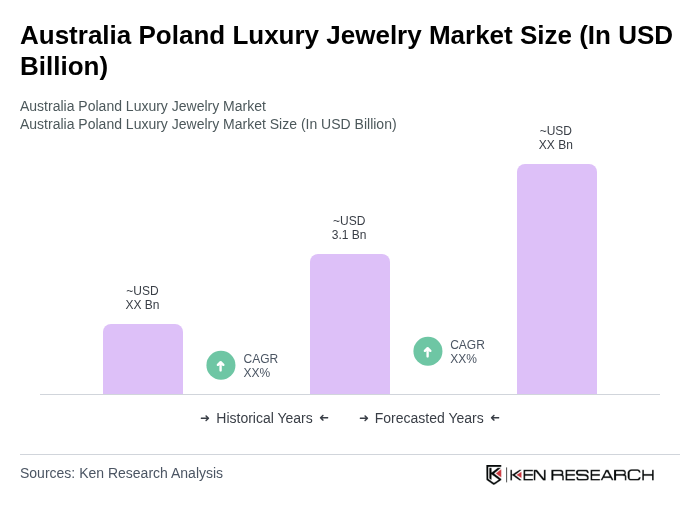
The Australia Poland Luxury Jewelry Market, worth USD 3.1 billion, is fueled by increasing luxury spending, bespoke jewelry trends, and strong retail in urban hubs, with gold and diamonds leading materials.

Region:Global

Author(s):Shubham

Product Code:KRAC5244

Pages:80

Published On:January 2026
About the Report

Base Year 2025

Australia Poland Luxury Jewelry Market Overview

  • The Australia Poland Luxury Jewelry Market is valued at USD 3.1 billion, based on a five-year historical analysis, reflecting the combined contribution of Australia’s fine and luxury jewelry segment and Poland’s luxury jewelry revenues. This growth is primarily driven by increasing disposable incomes, the expansion of affluent and upper-middle-income consumer groups, and a rising trend in luxury spending, including demand for personalized and bespoke pieces. Consumers are showing a growing appreciation for fine craftsmanship and branded jewelry, and the market has seen a notable uptick in demand for high-end jewelry in major urban areas with higher wealth concentration and strong luxury retail infrastructure.
  • Key urban centers for this market include Sydney and Melbourne in Australia and Warsaw in Poland, which dominate due to their status as major economic and cultural hubs with strong luxury retail corridors. These cities are characterized by a high concentration of affluent consumers, premium shopping districts, flagship boutiques of global luxury brands, and established local jewelers, making them prime locations for luxury jewelry sales and brand-building. The presence of international maisons alongside strong domestic players and artisans further enhances their market position, with omnichannel strategies (boutiques plus e?commerce) increasingly important to reach younger luxury buyers.
  • In Australia, consumer protection and quality standards in the jewelry sector are supported by hallmarking, trade measurement, and disclosure obligations, including requirements under the Australian Consumer Law and the National Measurement Act 1960 administered by the National Measurement Institute for accurate representation of precious metal content and weight. In Poland, the luxury jewelry segment falls under the national hallmarking and assay framework, including the Polish hallmarking regulations aligned with the Act on Assay and Hallmarking issued by Polish authorities, which set rules for the fineness marking and control of precious metal products sold on the market. These instruments aim to ensure that precious metals and gemstones are accurately described and certified, supporting consumer confidence, transparent trade practices, and growing adoption of ethical and responsibly sourced materials in higher-end jewelry.
Australia Poland Luxury Jewelry Market Size

Australia Poland Luxury Jewelry Market Segmentation

By Product Type:The product type segmentation includes various categories such as rings, necklaces & pendants, earrings, bracelets & bangles, watches & accessories, and others. Rings and necklaces remain core revenue contributors in fine and luxury jewelry due to their central role in engagements, weddings, and gifting, as well as their fashion relevance. The trend towards customization, including bespoke engagement rings, stackable bands, and personalized pendants, together with growing interest in bridal and occasion-led purchases, has led to increased demand in these segments, particularly among younger consumers seeking unique designs.
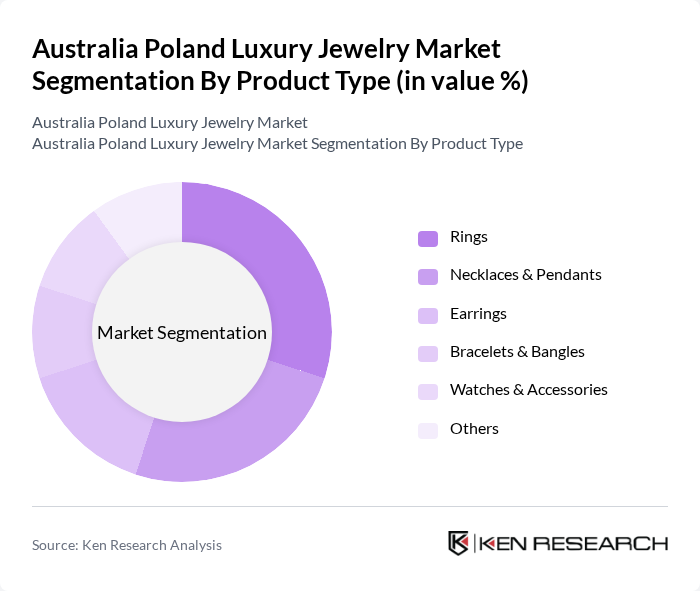
Australia Poland Luxury Jewelry Market segmentation by Product Type.

By Material:The material segmentation encompasses gold, platinum, silver, diamonds, precious gemstones, pearls, and others. Gold remains the most sought-after material in both fine and luxury jewelry because of its role in investment?oriented pieces, bridal jewelry, and timeless designs, while diamond jewelry is gaining share as consumers trade up to higher-quality stones and branded settings. The increasing popularity of ethical sourcing and sustainability, including recycled precious metals and lab?grown or ethically certified diamonds, has led to a rise in demand for responsibly sourced materials and traceable supply chains, particularly among younger, digitally engaged luxury consumers.
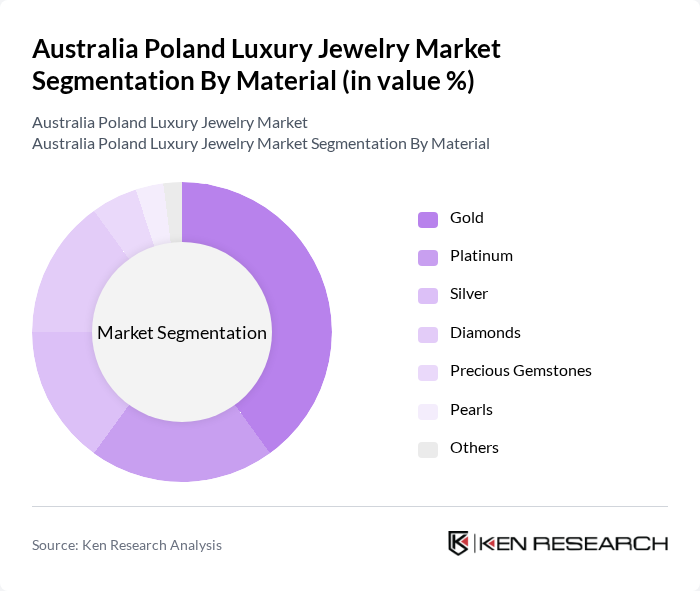
Australia Poland Luxury Jewelry Market segmentation by Material.

Australia Poland Luxury Jewelry Market Competitive Landscape

The Australia Poland Luxury Jewelry Market is characterized by a dynamic mix of regional and international players. Leading participants such as Paspaley, Michael Hill International, Pandora, Tiffany & Co., Bulgari, Cartier, Chopard, Graff, Harry Winston, Van Cleef & Arpels, Boucheron, Swarovski, Apart (Poland), W.Kruk, Local Independent Luxury Maisons (Australia & Poland) contribute to innovation, geographic expansion, and service delivery in this space.

Paspaley

1935

Darwin, Australia

Michael Hill International

1979

Brisbane, Australia

Pandora

1982

Copenhagen, Denmark

Tiffany & Co.

1837

New York, USA

Bulgari

1884

Rome, Italy

Company

Establishment Year

Headquarters

Group Size (Large, Medium, or Small as per industry convention)

Revenue Growth Rate (3–5 Year CAGR)

Luxury Jewelry Revenue (Regional, Latest Year)

EBITDA Margin from Jewelry Segment

Average Selling Price (ASPs) by Key Category

Same-Store Sales Growth (Retail Network)

Australia Poland Luxury Jewelry Market Industry Analysis

Growth Drivers

  • Increasing Disposable Income:The average disposable income in Australia is projected to reach AUD 1,300 per week in future, reflecting a 3% increase from 2023. This rise in disposable income allows consumers to allocate more funds towards luxury items, including jewelry. In Poland, the average disposable income is expected to be PLN 2,700 per month, which supports increased spending on luxury goods. This financial flexibility is a significant driver for the luxury jewelry market in both countries.
  • Rising Demand for Personalized Jewelry:The personalized jewelry segment is experiencing robust growth, with sales expected to reach AUD 500 million in Australia and PLN 200 million in Poland in future. This trend is driven by consumers seeking unique, customized pieces that reflect their personal stories. The increasing popularity of bespoke jewelry is supported by a growing number of artisans and brands offering tailored services, enhancing the appeal of luxury jewelry in both markets.
  • Growth of E-commerce Platforms:E-commerce sales in the luxury jewelry sector are projected to exceed AUD 300 million in Australia and PLN 150 million in Poland in future. The convenience of online shopping, coupled with enhanced digital marketing strategies, is attracting a broader customer base. Major luxury brands are investing in their online presence, which is crucial for reaching tech-savvy consumers who prefer shopping from home, thus driving market growth in both regions.

Market Challenges

  • Economic Fluctuations:Economic instability poses a significant challenge for the luxury jewelry market. In Australia, the GDP growth rate is projected to slow to 1.8% in future, while Poland's GDP growth is expected to be around 0.2%. These fluctuations can lead to reduced consumer spending on luxury items, as economic uncertainty often results in cautious purchasing behavior. Brands must navigate these challenges to maintain sales and market share.
  • High Competition Among Luxury Brands:The luxury jewelry market is characterized by intense competition, with over 50 established brands vying for market share in Australia and Poland. This saturation leads to price wars and increased marketing expenditures, which can erode profit margins. In future, the competitive landscape is expected to intensify, requiring brands to differentiate themselves through unique offerings and superior customer experiences to remain relevant.

Australia Poland Luxury Jewelry Market Future Outlook

The future of the luxury jewelry market in Australia and Poland appears promising, driven by evolving consumer preferences and technological advancements. As sustainability becomes a priority, brands that adopt ethical sourcing and eco-friendly practices are likely to attract a loyal customer base. Additionally, the integration of augmented reality in online shopping experiences is expected to enhance consumer engagement, making luxury jewelry more accessible and appealing. These trends will shape the market landscape in the coming years.

Market Opportunities

  • Expansion into Emerging Markets:Luxury jewelry brands have a significant opportunity to expand into emerging markets in Southeast Asia, where the middle class is growing rapidly. With an estimated 300 million new consumers entering the market in future, brands can tap into this demographic's increasing disposable income and appetite for luxury goods, potentially boosting sales significantly.
  • Collaborations with Fashion Designers:Collaborations between luxury jewelry brands and renowned fashion designers can create unique collections that attract attention and drive sales. Such partnerships can leverage the designer's existing customer base, with potential revenue increases of up to 20% for participating brands. This strategy not only enhances brand visibility but also fosters innovation in jewelry design, appealing to fashion-forward consumers.

Scope of the Report

SegmentSub-Segments
By Product Type

Rings

Necklaces & Pendants

Earrings

Bracelets & Bangles

Watches & Accessories

Others

By Material

Gold

Platinum

Silver

Diamonds

Precious Gemstones

Pearls

Others

By Collection / Design

Bridal & Wedding Jewelry

High Jewelry (Haute Joaillerie)

Everyday Luxury / Contemporary Classics

Limited Edition & Collaboration Lines

Heritage & Vintage-Inspired Collections

By End User

Women

Men

Unisex

Children & Young Adults

By Distribution Channel

Mono-brand Luxury Boutiques

Multi-brand Jewelry Retailers

Department & Duty-Free Stores

Online Brand Stores (D2C)

E-commerce Marketplaces

Travel Retail and Others

By Price Band

Entry Luxury (Accessible Luxury)

Core Luxury

Ultra-High-End / High Jewelry

By Occasion / Usage

Engagement & Wedding

Festive & Cultural Events

Gifting (Personal & Corporate)

Self-purchase / Investment

Others

Key Target Audience

Investors and Venture Capitalist Firms

Government and Regulatory Bodies (e.g., Australian Competition and Consumer Commission, Polish Ministry of Economic Development)

Luxury Jewelry Manufacturers and Producers

Distributors and Retailers of Luxury Goods

Trade Associations (e.g., Jewelry Association of Australia, Polish Chamber of Commerce)

Luxury Brand Management Firms

Financial Institutions and Investment Banks

Importers and Exporters of Luxury Jewelry

Players Mentioned in the Report:

Paspaley

Michael Hill International

Pandora

Tiffany & Co.

Bulgari

Cartier

Chopard

Graff

Harry Winston

Van Cleef & Arpels

Boucheron

Swarovski

Apart (Poland)

W.Kruk

Local Independent Luxury Maisons (Australia & Poland)

Table of Contents

Market Assessment Phase

1. Executive Summary and Approach


2. Australia Poland Luxury Jewelry Market Overview

2.1 Key Insights and Strategic Recommendations

2.2 Australia Poland Luxury Jewelry Market Overview

2.3 Definition and Scope

2.4 Evolution of Market Ecosystem

2.5 Timeline of Key Regulatory Milestones

2.6 Value Chain & Stakeholder Mapping

2.7 Business Cycle Analysis

2.8 Policy & Incentive Landscape


3. Australia Poland Luxury Jewelry Market Analysis

3.1 Growth Drivers

3.1.1 Increasing disposable income
3.1.2 Rising demand for personalized jewelry
3.1.3 Growth of e-commerce platforms
3.1.4 Influence of social media on luxury purchases

3.2 Market Challenges

3.2.1 Economic fluctuations
3.2.2 High competition among luxury brands
3.2.3 Changing consumer preferences
3.2.4 Supply chain disruptions

3.3 Market Opportunities

3.3.1 Expansion into emerging markets
3.3.2 Collaborations with fashion designers
3.3.3 Sustainable and ethical jewelry trends
3.3.4 Technological advancements in jewelry design

3.4 Market Trends

3.4.1 Customization and bespoke services
3.4.2 Rise of online luxury shopping
3.4.3 Increased focus on sustainability
3.4.4 Use of augmented reality in shopping experiences

3.5 Government Regulation

3.5.1 Import tariffs on luxury goods
3.5.2 Consumer protection laws
3.5.3 Regulations on ethical sourcing
3.5.4 Advertising standards for luxury products

4. SWOT Analysis


5. Stakeholder Analysis


6. Porter's Five Forces Analysis


7. Australia Poland Luxury Jewelry Market Market Size, 2019-2024

7.1 By Value

7.2 By Volume

7.3 By Average Selling Price


8. Australia Poland Luxury Jewelry Market Segmentation

8.1 By Product Type

8.1.1 Rings
8.1.2 Necklaces & Pendants
8.1.3 Earrings
8.1.4 Bracelets & Bangles
8.1.5 Watches & Accessories
8.1.6 Others

8.2 By Material

8.2.1 Gold
8.2.2 Platinum
8.2.3 Silver
8.2.4 Diamonds
8.2.5 Precious Gemstones
8.2.6 Pearls
8.2.7 Others

8.3 By Collection / Design

8.3.1 Bridal & Wedding Jewelry
8.3.2 High Jewelry (Haute Joaillerie)
8.3.3 Everyday Luxury / Contemporary Classics
8.3.4 Limited Edition & Collaboration Lines
8.3.5 Heritage & Vintage-Inspired Collections

8.4 By End User

8.4.1 Women
8.4.2 Men
8.4.3 Unisex
8.4.4 Children & Young Adults

8.5 By Distribution Channel

8.5.1 Mono-brand Luxury Boutiques
8.5.2 Multi-brand Jewelry Retailers
8.5.3 Department & Duty-Free Stores
8.5.4 Online Brand Stores (D2C)
8.5.5 E-commerce Marketplaces
8.5.6 Travel Retail and Others

8.6 By Price Band

8.6.1 Entry Luxury (Accessible Luxury)
8.6.2 Core Luxury
8.6.3 Ultra-High-End / High Jewelry

8.7 By Occasion / Usage

8.7.1 Engagement & Wedding
8.7.2 Festive & Cultural Events
8.7.3 Gifting (Personal & Corporate)
8.7.4 Self-purchase / Investment
8.7.5 Others

9. Australia Poland Luxury Jewelry Market Competitive Analysis

9.1 Market Share of Key Players

9.2 Cross Comparison of Key Players

9.2.1 Company Name
9.2.2 Group Size (Large, Medium, or Small as per industry convention)
9.2.3 Revenue Growth Rate (3–5 Year CAGR)
9.2.4 Luxury Jewelry Revenue (Regional, Latest Year)
9.2.5 EBITDA Margin from Jewelry Segment
9.2.6 Average Selling Price (ASPs) by Key Category
9.2.7 Same-Store Sales Growth (Retail Network)
9.2.8 E-commerce Share of Total Sales
9.2.9 Store Footprint (Number of Stores / Boutiques)
9.2.10 Customer Retention / Repeat Purchase Rate
9.2.11 Marketing Spend as % of Sales
9.2.12 Market Share in Australia and Poland

9.3 SWOT Analysis of Top Players

9.4 Pricing Analysis

9.5 Detailed Profile of Major Companies

9.5.1 Paspaley
9.5.2 Michael Hill International
9.5.3 Pandora
9.5.4 Tiffany & Co.
9.5.5 Bulgari
9.5.6 Cartier
9.5.7 Chopard
9.5.8 Graff
9.5.9 Harry Winston
9.5.10 Van Cleef & Arpels
9.5.11 Boucheron
9.5.12 Swarovski
9.5.13 Apart (Poland)
9.5.14 W.Kruk
9.5.15 Local Independent Luxury Maisons (Australia & Poland)

10. Australia Poland Luxury Jewelry Market End-User Analysis

10.1 Procurement Behavior of Key Ministries

10.1.1 Government procurement policies
10.1.2 Budget allocation for luxury items
10.1.3 Supplier selection criteria
10.1.4 Contract management practices

10.2 Corporate Spend on Infrastructure & Energy

10.2.1 Investment in luxury branding
10.2.2 Spending on corporate gifts
10.2.3 Budget for employee rewards
10.2.4 Others

10.3 Pain Point Analysis by End-User Category

10.3.1 Quality concerns
10.3.2 Availability of designs
10.3.3 Pricing transparency
10.3.4 After-sales service issues

10.4 User Readiness for Adoption

10.4.1 Awareness of luxury brands
10.4.2 Willingness to pay premium prices
10.4.3 Familiarity with online purchasing
10.4.4 Others

10.5 Post-Deployment ROI and Use Case Expansion

10.5.1 Measurement of customer satisfaction
10.5.2 Analysis of repeat purchases
10.5.3 Evaluation of brand loyalty
10.5.4 Others

11. Australia Poland Luxury Jewelry Market Future Size, 2025-2030

11.1 By Value

11.2 By Volume

11.3 By Average Selling Price


Go-To-Market Strategy Phase

1. Whitespace Analysis + Business Model Canvas

1.1 Market gaps identification

1.2 Value proposition development

1.3 Revenue model exploration

1.4 Customer segmentation analysis

1.5 Competitive landscape overview

1.6 Key partnerships identification

1.7 Operational framework design


2. Marketing and Positioning Recommendations

2.1 Branding strategies

2.2 Product USPs

2.3 Target audience definition

2.4 Marketing channels selection

2.5 Campaign planning

2.6 Performance metrics

2.7 Feedback mechanisms


3. Distribution Plan

3.1 Urban retail vs rural NGO tie-ups

3.2 Online vs offline strategies

3.3 Logistics and supply chain management

3.4 Partnership with distributors

3.5 Inventory management

3.6 Customer service integration

3.7 Performance tracking


4. Channel & Pricing Gaps

4.1 Underserved routes

4.2 Pricing bands

4.3 Competitor pricing analysis

4.4 Value-based pricing strategies

4.5 Discounting policies

4.6 Price elasticity assessment

4.7 Customer perception of value


5. Unmet Demand & Latent Needs

5.1 Category gaps

5.2 Consumer segments

5.3 Emerging trends analysis

5.4 Customer feedback analysis

5.5 Market research findings

5.6 Innovation opportunities

5.7 Future demand forecasting


6. Customer Relationship

6.1 Loyalty programs

6.2 After-sales service

6.3 Customer engagement strategies

6.4 Feedback collection methods

6.5 Relationship management tools

6.6 Personalization efforts

6.7 Community building initiatives


7. Value Proposition

7.1 Sustainability

7.2 Integrated supply chains

7.3 Unique selling points

7.4 Customer-centric approach

7.5 Brand storytelling

7.6 Competitive advantages

7.7 Market differentiation strategies


8. Key Activities

8.1 Regulatory compliance

8.2 Branding

8.3 Distribution setup

8.4 Marketing execution

8.5 Performance monitoring

8.6 Risk management

8.7 Continuous improvement


9. Entry Strategy Evaluation

9.1 Domestic Market Entry Strategy

9.1.1 Product mix
9.1.2 Pricing band
9.1.3 Packaging

9.2 Export Entry Strategy

9.2.1 Target countries
9.2.2 Compliance roadmap

10. Entry Mode Assessment

10.1 JV

10.2 Greenfield

10.3 M&A

10.4 Distributor Model


11. Capital and Timeline Estimation

11.1 Capital requirements

11.2 Timelines


12. Control vs Risk Trade-Off

12.1 Ownership vs Partnerships


13. Profitability Outlook

13.1 Breakeven analysis

13.2 Long-term sustainability


14. Potential Partner List

14.1 Distributors

14.2 JVs

14.3 Acquisition targets


15. Execution Roadmap

15.1 Phased Plan for Market Entry

15.1.1 Market Setup
15.1.2 Market Entry
15.1.3 Growth Acceleration
15.1.4 Scale & Stabilize

15.2 Key Activities and Milestones

15.2.1 Activity planning
15.2.2 Milestone tracking

Research Methodology

ApproachModellingSample

Phase 1: Approach1

Desk Research

  • Analysis of industry reports from luxury jewelry associations in Australia and Poland
  • Review of market trends and consumer behavior studies published by market research firms
  • Examination of import/export data and trade statistics from government databases

Primary Research

  • Interviews with key stakeholders in the luxury jewelry sector, including designers and retailers
  • Surveys targeting affluent consumers to understand purchasing preferences and trends
  • Focus groups with jewelry enthusiasts to gather qualitative insights on brand perception

Validation & Triangulation

  • Cross-validation of findings through multiple data sources, including sales data and consumer surveys
  • Triangulation of insights from industry experts and market analysts
  • Sanity checks through expert panel discussions to ensure data reliability

Phase 2: Market Size Estimation1

Top-down Assessment

  • Estimation of the luxury jewelry market size based on national economic indicators and luxury spending trends
  • Segmentation of the market by product type, including fine jewelry, watches, and bespoke pieces
  • Incorporation of demographic data to assess potential market growth among affluent populations

Bottom-up Modeling

  • Collection of sales data from leading luxury jewelry retailers in both Australia and Poland
  • Estimation of average transaction values and purchase frequency among target consumer segments
  • Analysis of online vs. offline sales channels to determine market distribution

Forecasting & Scenario Analysis

  • Development of market forecasts using historical sales data and economic growth projections
  • Scenario analysis based on potential shifts in consumer behavior and economic conditions
  • Creation of baseline, optimistic, and pessimistic forecasts through 2030

Phase 3: CATI Sample Composition1

Scope Item/SegmentSample SizeTarget Respondent Profiles
Luxury Jewelry Retailers in Australia100Store Managers, Brand Representatives
High-Net-Worth Individuals in Poland90Affluent Consumers, Jewelry Collectors
Jewelry Designers and Artisans60Independent Designers, Workshop Owners
Luxury E-commerce Platforms70eCommerce Managers, Digital Marketing Specialists
Market Analysts and Industry Experts50Market Researchers, Economic Analysts

Frequently Asked Questions

What is the current value of the Australia Poland Luxury Jewelry Market?

The Australia Poland Luxury Jewelry Market is valued at approximately USD 3.1 billion, reflecting the combined contributions from Australias fine jewelry segment and Polands luxury jewelry revenues, driven by increasing disposable incomes and a rising trend in luxury spending.

Which cities are key markets for luxury jewelry in Australia and Poland?

What are the main product types in the luxury jewelry market?

How is the luxury jewelry market segmented by material?

Why Buy From Us?

Refine Robust Result (RRR) Framework

What makes us stand out is that our consultants follow Robust, Refine and Result (RRR) methodology. Robust for clear definitions, approaches and sanity checking, Refine for differentiating respondents' facts and opinions, and Result for presenting data with story.

Our Reach Is Unmatched

We have set a benchmark in the industry by offering our clients with syndicated and customized market research reports featuring coverage of entire market as well as meticulous research and analyst insights.

Shifting the Research Paradigm

While we don't replace traditional research, we flip the method upside down. Our dual approach of Top Bottom & Bottom Top ensures quality deliverable by not just verifying company fundamentals but also looking at the sector and macroeconomic factors.

More Insights-Better Decisions

With one step in the future, our research team constantly tries to show you the bigger picture. We help with some of the tough questions you may encounter along the way: How is the industry positioned? Best marketing channel? KPI's of competitors? By aligning every element, we help maximize success.

Transparency and Trust

Our report gives you instant access to the answers and sources that other companies might choose to hide. We elaborate each steps of research methodology we have used and showcase you the sample size to earn your trust.

Round the Clock Support

If you need any support, we are here! We pride ourselves on universe strength, data quality, and quick, friendly, and professional service.

Why Clients Choose Us?

400000+
Reports in repository
150+
Consulting projects a year
100+
Analysts
8000+
Client Queries in 2022








