Kuwait Poland Luxury Jewelry Market Report Size Share Growth Drivers Trends Opportunities & Forecast 2025–2030

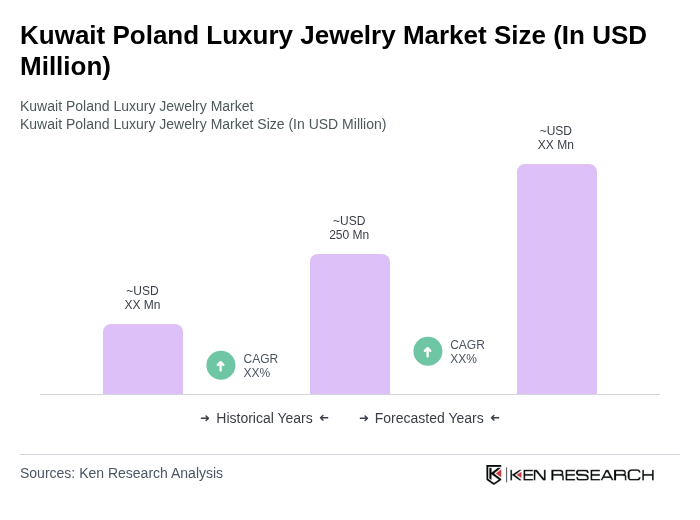
Kuwait Poland Luxury Jewelry Market, valued at USD 250 million, is growing due to increasing high-net-worth individuals, preference for bespoke designs, and sustainable practices in Kuwait and Poland.

Region:Europe

Author(s):Shubham

Product Code:KRAC5242

Pages:95

Published On:January 2026
About the Report

Base Year 2025

Kuwait Poland Luxury Jewelry Market Overview

  • The Kuwait Poland Luxury Jewelry Market is valued at USD 250 million, based on a five-year historical analysis and triangulation of Kuwait’s jewelry market and Poland’s luxury jewelry segment. This growth is primarily driven by increasing disposable incomes, a rising number of high-net-worth individuals, and a growing preference for luxury goods among consumers in both countries. The market has seen a significant uptick in demand for high-quality and unique jewelry pieces, with consumers increasingly favoring personalized, bespoke, and limited-edition designs, and showing growing interest in ethically sourced and sustainably produced luxury jewelry.
  • Key players in this market include major cities such as Kuwait City and Warsaw, which dominate due to their affluent populations, higher concentration of high-net-worth and aspirational consumers, and established luxury retail environments. The presence of international luxury brands in prime malls and high streets, alongside a growing trend of local craftsmanship and designer ateliers, further enhances the market's appeal in these regions, making them hubs for luxury jewelry shopping and experiential retail.
  • In Kuwait, regulations on precious metals and gemstones are framed under the Precious Metals and Gemstones Control Law issued by the Ministry of Commerce and Industry, which mandates hallmarking and quality control for gold, silver, and platinum jewelry sold in the local market. In Poland, the Regulation of the Minister of Finance on hallmarking and assay of precious metal articles, issued under the Polish hallmarking system, sets out binding requirements for assay, marking, and control of jewelry made from gold, silver, and platinum. These regulations require mandatory testing and certification of precious metals, standardized hallmarks, and oversight by authorized assay offices, helping ensure authenticity, transparency, and consumer protection in the luxury jewelry sector while supporting ethical and traceable sourcing practices.
Kuwait Poland Luxury Jewelry Market Size

Kuwait Poland Luxury Jewelry Market Segmentation

By Product Type:The product type segmentation includes various categories such as rings, necklaces & pendants, earrings, bracelets & bangles, brooches & pins, high jewelry/one-of-a-kind pieces, and others. Rings and necklaces remain key categories in global and European luxury jewelry markets, reflecting their versatility, symbolic value, and prominence in engagements, weddings, and gifting occasions. Earrings and bracelets are also increasingly favored as fashion-driven purchases, especially among younger and urban consumers who follow influencer and social media trends. The demand for high jewelry and one-of-a-kind pieces has surged among affluent clients and high-net-worth individuals, driven by a preference for exclusivity, investment-grade gemstones, and bespoke craftsmanship, often supported by private appointments and personalized design services.
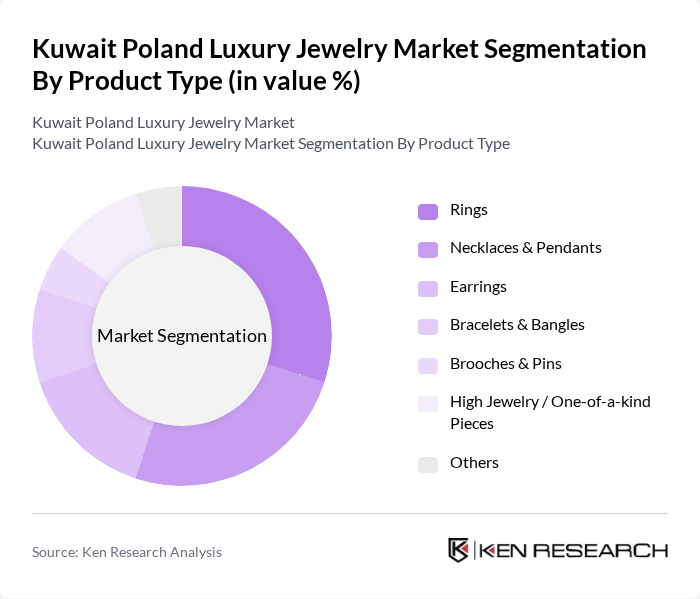
Kuwait Poland Luxury Jewelry Market segmentation by Product Type.

By Consumer Profile:The consumer profile segmentation includes women, men, unisex/gender-neutral, high-net-worth individuals (HNWIs), aspirational affluent consumers, and others. Women represent the largest segment, consistent with broader luxury jewelry markets where female consumers drive a substantial share of demand for both self-purchase and gifting. Men are an important and growing segment, particularly in categories such as watches, rings, bracelets, and cufflinks, supported by rising interest in personal grooming and status-driven accessories. Unisex and gender-neutral designs are gaining traction among younger demographics seeking contemporary, minimalist, and inclusive styles. High-net-worth individuals play a crucial role in the market as they seek exclusive, bespoke, and investment-oriented pieces, while aspirational affluent consumers increasingly trade up to branded luxury jewelry, often influenced by celebrities, social media, and global fashion trends.
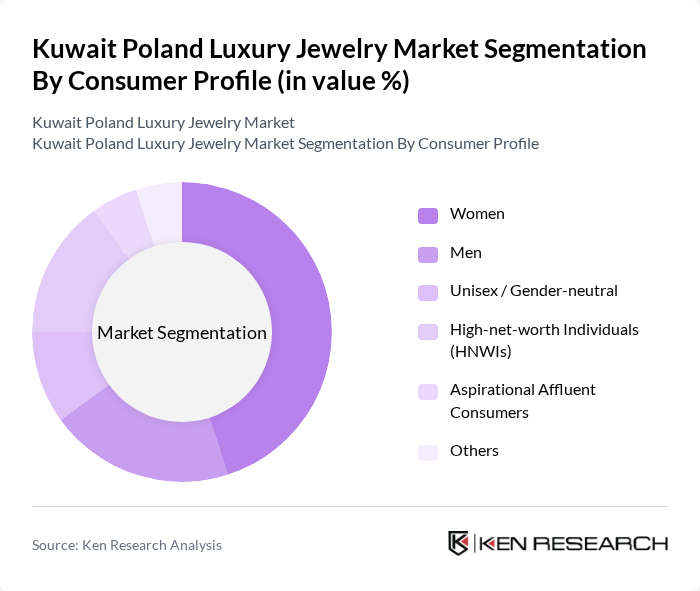
Kuwait Poland Luxury Jewelry Market segmentation by Consumer Profile.

Kuwait Poland Luxury Jewelry Market Competitive Landscape

The Kuwait Poland Luxury Jewelry Market is characterized by a dynamic mix of regional and international players. Leading participants such as Cartier, Tiffany & Co., Bvlgari, Chopard, Van Cleef & Arpels, Harry Winston, Piaget, Graff, Mikimoto, Buccellati, Damas Jewellery, L'azurde, Malabar Gold & Diamonds, Tanishq, and selected local and regional luxury jewelry houses in Kuwait and Poland contribute to innovation, geographic expansion, and service delivery in this space.

Cartier

1847

Paris, France

Tiffany & Co.

1837

New York, USA

Bvlgari

1884

Rome, Italy

Chopard

1860

Geneva, Switzerland

Van Cleef & Arpels

1906

Paris, France

Company

Establishment Year

Headquarters

Group Size (Large, Medium, or Small as per industry convention)

Regional Revenue in Kuwait & Poland (USD)

3-year CAGR in Kuwait & Poland Luxury Jewelry Revenue

Luxury Jewelry Market Share (%) in Kuwait & Poland

Store Footprint (Number of Physical Stores / POS)

E-commerce Penetration (% of Sales via Online Channels)

Kuwait Poland Luxury Jewelry Market Industry Analysis

Growth Drivers

  • Increasing Disposable Income:The average disposable income in Kuwait is projected to reach approximately $40,000 per capita in future, reflecting a 5% increase from the previous period. This rise in income enables consumers to allocate more funds towards luxury items, including jewelry. In Poland, the average disposable income is expected to be around $16,000 per capita, which has also seen a steady increase. This growing financial capacity is a significant driver for luxury jewelry purchases in both markets.
  • Rising Demand for Customization:The luxury jewelry sector is witnessing a notable shift towards personalized products, with 62% of consumers in Kuwait expressing a preference for customized jewelry options. In Poland, this trend is similarly reflected, with 57% of consumers valuing unique designs. This demand for customization is driven by consumers' desire for individuality and self-expression, prompting brands to innovate and offer bespoke services that cater to these preferences.
  • Growth of E-commerce Platforms:E-commerce sales in the luxury jewelry segment are expected to reach $1.3 billion in Kuwait and $600 million in Poland in future. The increasing penetration of the internet and mobile devices, coupled with a growing trend of online shopping, is facilitating this growth. Brands are investing in digital marketing strategies to enhance their online presence, making luxury jewelry more accessible to a broader audience in both regions.

Market Challenges

  • Economic Fluctuations:Economic instability poses a significant challenge for the luxury jewelry market. In Kuwait, fluctuations in oil prices can directly impact consumer spending, with a 12% drop in oil prices potentially leading to a 4% decrease in luxury goods sales. Similarly, Poland's economy is sensitive to global economic conditions, where a slowdown could reduce disposable income and affect luxury purchases, creating uncertainty for retailers.
  • High Competition:The luxury jewelry market is characterized by intense competition, with over 220 brands operating in Kuwait and around 160 in Poland. This saturation leads to price wars and aggressive marketing strategies, which can erode profit margins. Additionally, established brands face challenges from emerging local designers who are gaining popularity, making it essential for companies to differentiate their offerings to maintain market share.

Kuwait Poland Luxury Jewelry Market Future Outlook

The luxury jewelry market in Kuwait and Poland is poised for significant transformation, driven by evolving consumer preferences and technological advancements. As sustainability becomes a priority, brands are expected to adopt ethical sourcing practices, appealing to environmentally conscious consumers. Furthermore, the integration of augmented reality in online shopping experiences will enhance customer engagement, allowing for virtual try-ons. These trends indicate a dynamic market landscape that will require adaptability and innovation from luxury jewelry brands to thrive in the coming years.

Market Opportunities

  • Expansion into Emerging Markets:Luxury jewelry brands have a significant opportunity to expand into emerging markets in the Middle East and Eastern Europe. With a growing middle class and increasing disposable incomes, these regions present untapped potential for luxury goods, allowing brands to diversify their customer base and increase sales.
  • Collaborations with Influencers:Partnering with social media influencers can enhance brand visibility and credibility. In Kuwait and Poland, influencer marketing is gaining traction, with over 75% of consumers influenced by social media endorsements. Collaborations can drive engagement and attract younger demographics, creating a fresh avenue for growth in the luxury jewelry sector.

Scope of the Report

SegmentSub-Segments
By Product Type

Rings

Necklaces & Pendants

Earrings

Bracelets & Bangles

Brooches & Pins

High Jewelry / One-of-a-kind Pieces

Others

By Consumer Profile

Women

Men

Unisex / Gender-neutral

High-net-worth Individuals (HNWIs)

Aspirational Affluent Consumers

Others

By Purchase Occasion

Weddings & Engagements

Religious & Cultural Events

Gifting (Birthdays, Anniversaries, Festivals)

Self-purchase & Investment

Corporate & VIP Gifting

Others

By Material & Stone

Gold (18K, 21K, 22K, 24K)

Platinum & Palladium

Diamonds (Natural)

Lab-grown Diamonds

Colored Gemstones & Precious Pearls

Mixed Materials & Innovative Alloys

Others

By Distribution Channel

Branded Monobrand Boutiques

Multi-brand Luxury Retailers

Department Stores & Duty-free

Online Brand Store & E-commerce Marketplaces

Travel Retail & Airport Stores

Others

By Price Band

Accessible Luxury (Entry-level)

Core Luxury

High Luxury

Ultra-high / High Jewelry

Bespoke & Custom-made

Others

By Brand Origin

Global Heritage Maisons

Regional / GCC Brands

Polish & European Designer Brands

Local Independent Designers & Atelier Houses

Private-label & Retailer Brands

Others

Key Target Audience

Investors and Venture Capitalist Firms

Government and Regulatory Bodies (e.g., Ministry of Commerce and Industry, Kuwait Investment Authority)

Luxury Jewelry Manufacturers and Producers

Distributors and Retailers in Luxury Goods

High-Net-Worth Individuals and Collectors

Luxury Brand Management Firms

Trade Associations in the Jewelry Sector

Financial Institutions and Banks specializing in Luxury Assets

Players Mentioned in the Report:

Cartier

Tiffany & Co.

Bvlgari

Chopard

Van Cleef & Arpels

Harry Winston

Piaget

Graff

Mikimoto

Buccellati

Damas Jewellery

L'azurde

Malabar Gold & Diamonds

Tanishq

Selected Local & Regional Luxury Jewelry Houses in Kuwait and Poland

Table of Contents

Market Assessment Phase

1. Executive Summary and Approach


2. Kuwait Poland Luxury Jewelry Market Overview

2.1 Key Insights and Strategic Recommendations

2.2 Kuwait Poland Luxury Jewelry Market Overview

2.3 Definition and Scope

2.4 Evolution of Market Ecosystem

2.5 Timeline of Key Regulatory Milestones

2.6 Value Chain & Stakeholder Mapping

2.7 Business Cycle Analysis

2.8 Policy & Incentive Landscape


3. Kuwait Poland Luxury Jewelry Market Analysis

3.1 Growth Drivers

3.1.1 Increasing Disposable Income
3.1.2 Rising Demand for Customization
3.1.3 Growth of E-commerce Platforms
3.1.4 Influence of Social Media Marketing

3.2 Market Challenges

3.2.1 Economic Fluctuations
3.2.2 High Competition
3.2.3 Regulatory Compliance Issues
3.2.4 Changing Consumer Preferences

3.3 Market Opportunities

3.3.1 Expansion into Emerging Markets
3.3.2 Collaborations with Influencers
3.3.3 Sustainable Jewelry Trends
3.3.4 Technological Innovations in Design

3.4 Market Trends

3.4.1 Shift Towards Ethical Sourcing
3.4.2 Personalization and Customization
3.4.3 Digital Transformation in Retail
3.4.4 Increased Focus on Online Sales Channels

3.5 Government Regulation

3.5.1 Import Tariffs on Luxury Goods
3.5.2 Consumer Protection Laws
3.5.3 Environmental Regulations
3.5.4 Trade Agreements with Other Countries

4. SWOT Analysis


5. Stakeholder Analysis


6. Porter's Five Forces Analysis


7. Kuwait Poland Luxury Jewelry Market Market Size, 2019-2024

7.1 By Value

7.2 By Volume

7.3 By Average Selling Price


8. Kuwait Poland Luxury Jewelry Market Segmentation

8.1 By Product Type

8.1.1 Rings
8.1.2 Necklaces & Pendants
8.1.3 Earrings
8.1.4 Bracelets & Bangles
8.1.5 Brooches & Pins
8.1.6 High Jewelry / One-of-a-kind Pieces
8.1.7 Others

8.2 By Consumer Profile

8.2.1 Women
8.2.2 Men
8.2.3 Unisex / Gender-neutral
8.2.4 High-net-worth Individuals (HNWIs)
8.2.5 Aspirational Affluent Consumers
8.2.6 Others

8.3 By Purchase Occasion

8.3.1 Weddings & Engagements
8.3.2 Religious & Cultural Events
8.3.3 Gifting (Birthdays, Anniversaries, Festivals)
8.3.4 Self-purchase & Investment
8.3.5 Corporate & VIP Gifting
8.3.6 Others

8.4 By Material & Stone

8.4.1 Gold (18K, 21K, 22K, 24K)
8.4.2 Platinum & Palladium
8.4.3 Diamonds (Natural)
8.4.4 Lab-grown Diamonds
8.4.5 Colored Gemstones & Precious Pearls
8.4.6 Mixed Materials & Innovative Alloys
8.4.7 Others

8.5 By Distribution Channel

8.5.1 Branded Monobrand Boutiques
8.5.2 Multi-brand Luxury Retailers
8.5.3 Department Stores & Duty-free
8.5.4 Online Brand Store & E-commerce Marketplaces
8.5.5 Travel Retail & Airport Stores
8.5.6 Others

8.6 By Price Band

8.6.1 Accessible Luxury (Entry-level)
8.6.2 Core Luxury
8.6.3 High Luxury
8.6.4 Ultra-high / High Jewelry
8.6.5 Bespoke & Custom-made
8.6.6 Others

8.7 By Brand Origin

8.7.1 Global Heritage Maisons
8.7.2 Regional / GCC Brands
8.7.3 Polish & European Designer Brands
8.7.4 Local Independent Designers & Atelier Houses
8.7.5 Private-label & Retailer Brands
8.7.6 Others

9. Kuwait Poland Luxury Jewelry Market Competitive Analysis

9.1 Market Share of Key Players

9.2 Cross Comparison of Key Players

9.2.1 Company Name
9.2.2 Group Size (Large, Medium, or Small as per industry convention)
9.2.3 Regional Revenue in Kuwait & Poland (USD)
9.2.4 3-year CAGR in Kuwait & Poland Luxury Jewelry Revenue
9.2.5 Luxury Jewelry Market Share (%) in Kuwait & Poland
9.2.6 Store Footprint (Number of Physical Stores / POS)
9.2.7 E-commerce Penetration (% of Sales via Online Channels)
9.2.8 Average Transaction Value (USD per Customer)
9.2.9 Gross Margin (%) on Luxury Jewelry Portfolio
9.2.10 Marketing & Branding Intensity (% of Revenue Spent on Marketing)
9.2.11 Customer Lifetime Value to Customer Acquisition Cost Ratio (CLV/CAC)
9.2.12 Repeat Purchase Rate (% of Returning Customers)

9.3 SWOT Analysis of Top Players

9.4 Pricing Analysis

9.5 Detailed Profile of Major Companies

9.5.1 Cartier
9.5.2 Tiffany & Co.
9.5.3 Bvlgari
9.5.4 Chopard
9.5.5 Van Cleef & Arpels
9.5.6 Harry Winston
9.5.7 Piaget
9.5.8 Graff
9.5.9 Mikimoto
9.5.10 Buccellati
9.5.11 Damas Jewellery
9.5.12 L'azurde
9.5.13 Malabar Gold & Diamonds
9.5.14 Tanishq
9.5.15 Selected Local & Regional Luxury Jewelry Houses in Kuwait and Poland

10. Kuwait Poland Luxury Jewelry Market End-User Analysis

10.1 Procurement Behavior of Key Ministries

10.1.1 Budget Allocation Trends
10.1.2 Preferred Suppliers
10.1.3 Procurement Processes
10.1.4 Compliance Requirements

10.2 Corporate Spend on Infrastructure & Energy

10.2.1 Investment Trends
10.2.2 Key Projects
10.2.3 Spending Patterns
10.2.4 Future Projections

10.3 Pain Point Analysis by End-User Category

10.3.1 Quality Concerns
10.3.2 Supply Chain Issues
10.3.3 Pricing Pressures
10.3.4 Service Expectations

10.4 User Readiness for Adoption

10.4.1 Awareness Levels
10.4.2 Adoption Barriers
10.4.3 Training Needs
10.4.4 Support Requirements

10.5 Post-Deployment ROI and Use Case Expansion

10.5.1 Performance Metrics
10.5.2 Use Case Success Stories
10.5.3 Future Investment Opportunities
10.5.4 Lessons Learned

11. Kuwait Poland Luxury Jewelry Market Future Size, 2025-2030

11.1 By Value

11.2 By Volume

11.3 By Average Selling Price


Go-To-Market Strategy Phase

1. Whitespace Analysis + Business Model Canvas

1.1 Market Gaps Identification

1.2 Business Model Framework


2. Marketing and Positioning Recommendations

2.1 Branding Strategies

2.2 Product USPs


3. Distribution Plan

3.1 Urban Retail vs Rural NGO Tie-ups


4. Channel & Pricing Gaps

4.1 Underserved Routes

4.2 Pricing Bands


5. Unmet Demand & Latent Needs

5.1 Category Gaps

5.2 Consumer Segments


6. Customer Relationship

6.1 Loyalty Programs

6.2 After-sales Service


7. Value Proposition

7.1 Sustainability

7.2 Integrated Supply Chains


8. Key Activities

8.1 Regulatory Compliance

8.2 Branding

8.3 Distribution Setup


9. Entry Strategy Evaluation

9.1 Domestic Market Entry Strategy

9.1.1 Product Mix
9.1.2 Pricing Band
9.1.3 Packaging

9.2 Export Entry Strategy

9.2.1 Target Countries
9.2.2 Compliance Roadmap

10. Entry Mode Assessment

10.1 JV

10.2 Greenfield

10.3 M&A

10.4 Distributor Model


11. Capital and Timeline Estimation

11.1 Capital Requirements

11.2 Timelines


12. Control vs Risk Trade-Off

12.1 Ownership vs Partnerships


13. Profitability Outlook

13.1 Breakeven Analysis

13.2 Long-term Sustainability


14. Potential Partner List

14.1 Distributors

14.2 JVs

14.3 Acquisition Targets


15. Execution Roadmap

15.1 Phased Plan for Market Entry

15.1.1 Market Setup
15.1.2 Market Entry
15.1.3 Growth Acceleration
15.1.4 Scale & Stabilize

15.2 Key Activities and Milestones

15.2.1 Milestone Tracking
15.2.2 Activity Scheduling

Research Methodology

ApproachModellingSample

Phase 1: Approach1

Desk Research

  • Analysis of luxury jewelry market reports from industry associations and trade publications
  • Review of import/export data from Kuwait and Poland's customs authorities
  • Examination of consumer behavior studies and market trends from reputable market research firms

Primary Research

  • Interviews with key stakeholders in the luxury jewelry sector, including retailers and manufacturers
  • Surveys targeting affluent consumers in Kuwait and Poland to understand purchasing preferences
  • Focus groups with jewelry designers and artisans to gather insights on market dynamics

Validation & Triangulation

  • Cross-validation of findings through multiple data sources, including sales data and consumer feedback
  • Triangulation of insights from primary interviews with secondary research findings
  • Sanity checks conducted through expert panel reviews comprising industry veterans

Phase 2: Market Size Estimation1

Top-down Assessment

  • Estimation of market size based on national luxury goods spending trends in Kuwait and Poland
  • Segmentation of the market by product categories, including fine jewelry, watches, and bespoke pieces
  • Incorporation of demographic data to assess potential market growth among affluent consumers

Bottom-up Modeling

  • Collection of sales data from leading luxury jewelry retailers in both countries
  • Estimation of average transaction values and purchase frequencies among target demographics
  • Volume x value calculations to derive total market size for luxury jewelry

Forecasting & Scenario Analysis

  • Multi-factor regression analysis incorporating economic indicators and consumer confidence indices
  • Scenario modeling based on potential shifts in consumer spending and luxury market trends
  • Development of baseline, optimistic, and pessimistic forecasts through 2030

Phase 3: CATI Sample Composition1

Scope Item/SegmentSample SizeTarget Respondent Profiles
Luxury Jewelry Retailers in Kuwait80Store Managers, Sales Executives
Affluent Consumers in Poland120High Net Worth Individuals, Luxury Shoppers
Jewelry Designers and Artisans60Independent Designers, Workshop Owners
Market Analysts and Experts40Industry Analysts, Market Researchers
Luxury Brand Representatives70Brand Managers, Marketing Directors

Frequently Asked Questions

What is the current value of the Kuwait Poland Luxury Jewelry Market?

The Kuwait Poland Luxury Jewelry Market is valued at approximately USD 250 million, driven by increasing disposable incomes and a growing preference for luxury goods among consumers in both countries.

What factors are driving growth in the Kuwait Poland Luxury Jewelry Market?

Which cities are the main hubs for luxury jewelry in Kuwait and Poland?

What are the key product types in the Kuwait Poland Luxury Jewelry Market?

Why Buy From Us?

Refine Robust Result (RRR) Framework

What makes us stand out is that our consultants follow Robust, Refine and Result (RRR) methodology. Robust for clear definitions, approaches and sanity checking, Refine for differentiating respondents' facts and opinions, and Result for presenting data with story.

Our Reach Is Unmatched

We have set a benchmark in the industry by offering our clients with syndicated and customized market research reports featuring coverage of entire market as well as meticulous research and analyst insights.

Shifting the Research Paradigm

While we don't replace traditional research, we flip the method upside down. Our dual approach of Top Bottom & Bottom Top ensures quality deliverable by not just verifying company fundamentals but also looking at the sector and macroeconomic factors.

More Insights-Better Decisions

With one step in the future, our research team constantly tries to show you the bigger picture. We help with some of the tough questions you may encounter along the way: How is the industry positioned? Best marketing channel? KPI's of competitors? By aligning every element, we help maximize success.

Transparency and Trust

Our report gives you instant access to the answers and sources that other companies might choose to hide. We elaborate each steps of research methodology we have used and showcase you the sample size to earn your trust.

Round the Clock Support

If you need any support, we are here! We pride ourselves on universe strength, data quality, and quick, friendly, and professional service.

Why Clients Choose Us?

400000+
Reports in repository
150+
Consulting projects a year
100+
Analysts
8000+
Client Queries in 2022








