Region:Asia
Author(s):Rebecca
Product Code:KRAE3463
Pages:92
Published On:February 2026
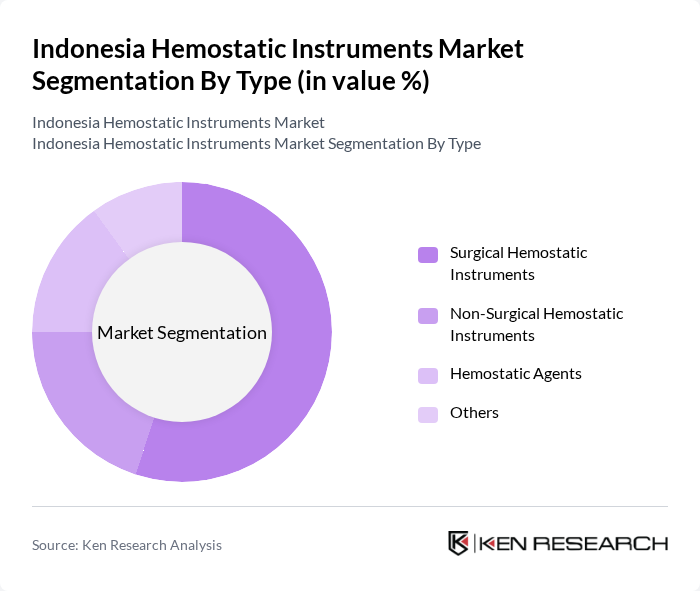
By Type:The market is segmented into Surgical Hemostatic Instruments, Non-Surgical Hemostatic Instruments, Hemostatic Agents, and Others. Surgical Hemostatic Instruments are leading the market due to their essential role in various surgical procedures, ensuring effective blood loss management. Non-Surgical Hemostatic Instruments and Hemostatic Agents are also gaining traction as they provide alternative solutions for managing bleeding in non-invasive settings. The demand for these products is driven by the increasing number of surgical interventions and the growing emphasis on patient safety.
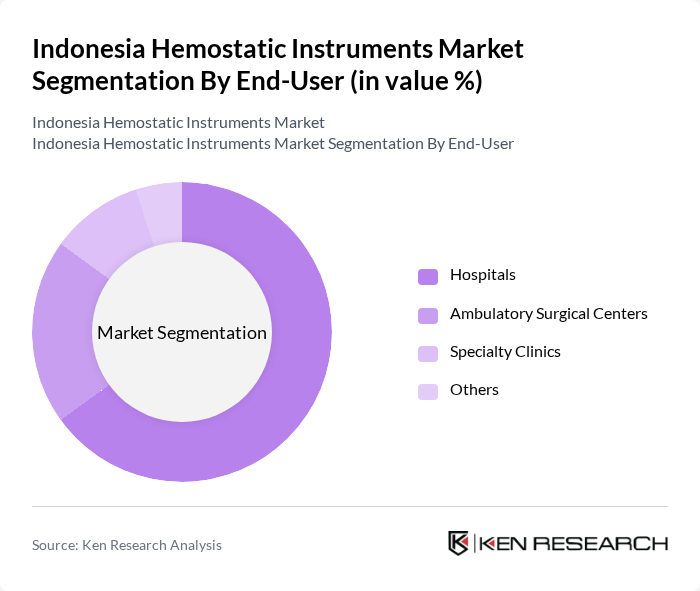
By End-User:The market is segmented into Hospitals, Ambulatory Surgical Centers, Specialty Clinics, and Others. Hospitals are the dominant end-user segment, accounting for a significant share of the market due to the high volume of surgical procedures performed in these facilities. Ambulatory Surgical Centers are also witnessing growth as they provide cost-effective and efficient surgical services. Specialty Clinics are increasingly adopting hemostatic instruments to cater to specific surgical needs, further driving market demand.
The Indonesia Hemostatic Instruments Market is characterized by a dynamic mix of regional and international players. Leading participants such as PT. Medika Sarana Trijaya, PT. Indofarma Tbk, PT. Kimia Farma Tbk, Johnson & Johnson Medical Indonesia, B. Braun Medical Indonesia, Medtronic Indonesia, Stryker Indonesia, Terumo Indonesia, Smith & Nephew Indonesia, Abbott Indonesia, Boston Scientific Indonesia, Olympus Indonesia, GE Healthcare Indonesia, Philips Healthcare Indonesia, Siemens Healthineers Indonesia contribute to innovation, geographic expansion, and service delivery in this space.
The future of the Indonesia hemostatic instruments market appears promising, driven by ongoing healthcare reforms and increased investments in medical infrastructure. As the government aims to enhance healthcare accessibility, particularly in rural areas, the demand for innovative hemostatic solutions is expected to rise. Additionally, the growing trend towards minimally invasive surgeries will further propel the market, as these procedures often require advanced hemostatic instruments to ensure patient safety and effective blood management.
| Segment | Sub-Segments |
|---|---|
| By Type | Surgical Hemostatic Instruments Non-Surgical Hemostatic Instruments Hemostatic Agents Others |
| By End-User | Hospitals Ambulatory Surgical Centers Specialty Clinics Others |
| By Application | Cardiovascular Surgery Orthopedic Surgery General Surgery Others |
| By Distribution Channel | Direct Sales Distributors Online Sales Others |
| By Region | Java Sumatra Bali and Nusa Tenggara Kalimantan Sulawesi Others |
| By Product Type | Disposable Instruments Reusable Instruments Others |
| By Technology | Mechanical Hemostasis Chemical Hemostasis Thermal Hemostasis Others |
| Scope Item/Segment | Sample Size | Target Respondent Profiles |
|---|---|---|
| General Surgery Departments | 100 | Surgeons, Surgical Nurses |
| Trauma Care Units | 80 | Emergency Room Physicians, Trauma Coordinators |
| Orthopedic Surgery Clinics | 70 | Orthopedic Surgeons, Clinic Managers |
| Cardiovascular Surgery Centers | 60 | Cardiothoracic Surgeons, Anesthesiologists |
| Medical Supply Distributors | 90 | Procurement Managers, Sales Representatives |
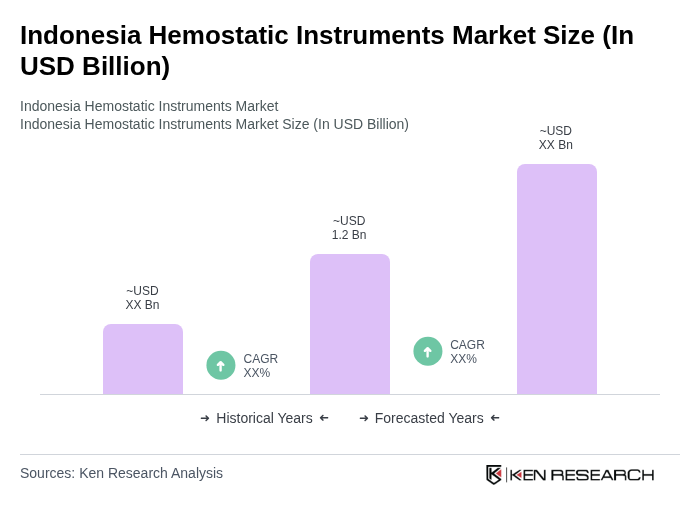
The Indonesia Hemostatic Instruments Market is valued at approximately USD 1.2 billion, reflecting a significant growth driven by the increasing prevalence of surgical procedures and advancements in medical technology.

What makes us stand out is that our consultants follow Robust, Refine and Result (RRR) methodology. Robust for clear definitions, approaches and sanity checking, Refine for differentiating respondents' facts and opinions, and Result for presenting data with story.

We have set a benchmark in the industry by offering our clients with syndicated and customized market research reports featuring coverage of entire market as well as meticulous research and analyst insights.

While we don't replace traditional research, we flip the method upside down. Our dual approach of Top Bottom & Bottom Top ensures quality deliverable by not just verifying company fundamentals but also looking at the sector and macroeconomic factors.

With one step in the future, our research team constantly tries to show you the bigger picture. We help with some of the tough questions you may encounter along the way: How is the industry positioned? Best marketing channel? KPI's of competitors? By aligning every element, we help maximize success.

Our report gives you instant access to the answers and sources that other companies might choose to hide. We elaborate each steps of research methodology we have used and showcase you the sample size to earn your trust.

If you need any support, we are here! We pride ourselves on universe strength, data quality, and quick, friendly, and professional service.













