About the Report
Base Year 2024Malaysia Hydrogen Storage Market Overview
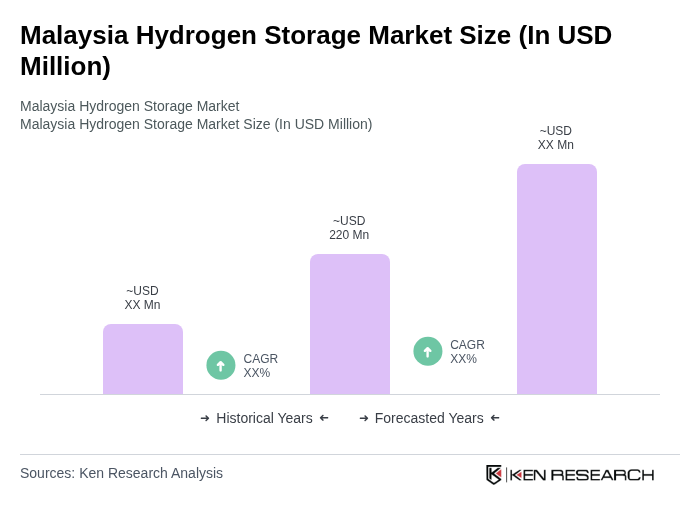
- The Malaysia Hydrogen Storage Market is valued at USD 220 million, based on a five-year historical analysis. This valuation aligns with Malaysia’s growing hydrogen value chain within a broader hydrogen generation market that generated revenue of about USD 1,923.6 million in 2024, supported by industrial hydrogen use in refining, ammonia, methanol, and emerging energy applications. Market growth is primarily driven by increasing investments in renewable energy and green hydrogen projects, particularly in Sarawak and other hydro-rich regions, government-backed decarbonization plans, and rising demand for hydrogen-based energy storage solutions across transportation, power, and industrial sectors.
- Key demand and development hubs for hydrogen and hydrogen storage in Malaysia include Sarawak (notably Bintulu and Kuching), as well as major industrial and logistics corridors around the Klang Valley (Greater Kuala Lumpur) and Johor, which benefit from strategic proximity to ports, petrochemical complexes, and power infrastructure.
- Malaysia’s policy direction for hydrogen is framed by national energy and climate strategies and by sectoral regulations that govern gas, power, and safety standards relevant to hydrogen storage infrastructure. A key binding reference is the Gas Supply (Amendment) Act 2016 issued by the Parliament of Malaysia under the purview of the Ministry of Energy and Natural Resources, which extends third-party access and licensing provisions in the gas supply system and sets safety and technical compliance requirements for gas facilities; these provisions are applied when developing hydrogen and hydrogen-blend infrastructure, including storage systems integrated into gas and power networks.
Malaysia Hydrogen Storage Market Segmentation
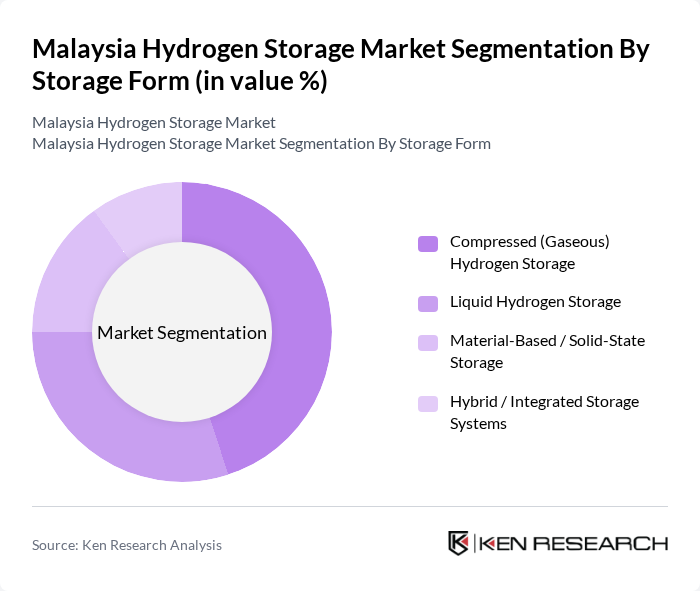
By Storage Form:The market is segmented into four storage forms: Compressed (Gaseous) Hydrogen Storage, Liquid Hydrogen Storage, Material-Based / Solid-State Storage, and Hybrid / Integrated Storage Systems. Compressed (Gaseous) Hydrogen Storage is currently the most widely deployed form globally and in Asia-Pacific owing to its technological maturity, standardized high-pressure cylinder and tube-trailer solutions, and relatively lower system cost, especially for mobility and industrial applications. Liquid Hydrogen Storage is gaining traction for applications that require high energy density and long-distance transport, including export-oriented projects and large-scale bunkering and refueling hubs. Material-Based / Solid-State Storage is emerging as a promising alternative for specific stationary and niche mobility uses due to safety advantages and potential for higher volumetric density, while Hybrid / Integrated Storage Systems are being explored to combine compressed, liquid, and material-based approaches for grid-scale, backup power, and multi-energy hub applications.
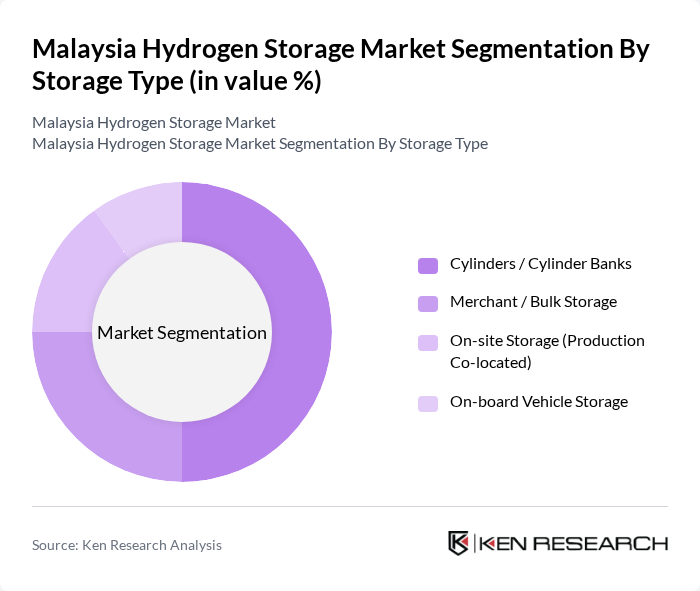
By Storage Type:The market is categorized into Cylinders / Cylinder Banks, Merchant / Bulk Storage, On-site Storage (Production Co-located), and On-board Vehicle Storage. The Cylinders / Cylinder Banks segment currently leads deployment worldwide because standardized cylinder packages, tube trailers, and cylinder banks are widely used for industrial gases and early-stage hydrogen applications, offering flexibility for small to medium users. Merchant / Bulk Storage, including large tanks and underground or above-ground bulk systems, is increasingly important for refineries, petrochemicals, and prospective export terminals. On-site Storage (Production Co-located) is gaining prominence as green and low-carbon hydrogen projects integrate storage with electrolysers and production units to buffer variable renewable generation and balance industrial demand. On-board Vehicle Storage, primarily high-pressure composite tanks for fuel cell vehicles, buses, trucks, and material-handling equipment, is a critical segment supporting hydrogen mobility initiatives in Asia-Pacific and underpins long-term growth in transport-related hydrogen demand.
Malaysia Hydrogen Storage Market Competitive Landscape
The Malaysia Hydrogen Storage Market is characterized by a dynamic mix of regional and international players. Leading participants such as PETRONAS (Petroliam Nasional Berhad), Tenaga Nasional Berhad, Sarawak Energy Berhad, Malakoff Corporation Berhad, YTL Power International Berhad, Sime Darby Berhad, UEM Group Berhad, Gas Malaysia Berhad, MMC Corporation Berhad, Sunway Construction Group Berhad, SCIB (Sarawak Consolidated Industries Berhad), KNM Group Berhad, Dialog Group Berhad, Wah Seong Corporation Berhad, MISC Berhad contribute to innovation, geographic expansion, and service delivery in this space.
Malaysia Hydrogen Storage Market Industry Analysis
Growth Drivers
- Increasing Demand for Renewable Energy:Malaysia's renewable energy sector is projected to reach RM 33 billion in future, driven by a national target of 20% renewable energy in the energy mix. This shift is fueled by the global transition towards sustainable energy sources, with hydrogen storage playing a crucial role in balancing supply and demand. The government aims to increase renewable energy capacity to 31% in future, further enhancing the hydrogen storage market's growth potential.
- Government Initiatives and Support:The Malaysian government has allocated RM 1.5 billion for green technology initiatives under the current Malaysia Plan framework. This funding supports hydrogen technology development, including storage solutions. Additionally, the National Hydrogen Policy aims to establish a comprehensive framework for hydrogen production and utilization, which is expected to attract investments and foster innovation in hydrogen storage technologies, thereby driving market growth.
- Technological Advancements in Storage Solutions:Innovations in hydrogen storage technologies, such as metal hydrides and advanced composite materials, are enhancing storage efficiency and safety. For instance, the development of high-capacity storage systems is projected to reduce costs by 30% in future. These advancements are crucial for integrating hydrogen into various applications, including transportation and energy generation, thus propelling the hydrogen storage market in Malaysia.
Market Challenges
- High Initial Investment Costs:The capital required for hydrogen storage infrastructure is significant, with estimates ranging from RM 500 million to RM 1 billion for large-scale projects. This high initial investment poses a barrier to entry for many companies, limiting market participation. Additionally, the long payback period for hydrogen storage systems can deter potential investors, hindering the overall growth of the market in Malaysia.
- Limited Infrastructure Development:Malaysia's hydrogen infrastructure is still in its infancy, with only a few refueling stations and storage facilities currently operational. The lack of a comprehensive network for hydrogen distribution and storage limits the market's growth potential. According to the Ministry of Energy and Natural Resources, an investment of RM 2 billion is needed to develop a robust hydrogen infrastructure in future, which remains a significant challenge.
Malaysia Hydrogen Storage Market Future Outlook
The future of the hydrogen storage market in Malaysia appears promising, driven by increasing investments in renewable energy and supportive government policies. As the country aims to achieve its renewable energy targets, hydrogen is expected to play a pivotal role in energy transition. The integration of hydrogen into transportation and industrial applications will likely accelerate, supported by ongoing technological advancements and international collaborations, positioning Malaysia as a regional leader in hydrogen solutions.
Market Opportunities
- Expansion of Hydrogen Infrastructure:The Malaysian government is prioritizing the development of hydrogen infrastructure, with plans to establish 20 hydrogen refueling stations in future. This expansion presents significant opportunities for investment and partnerships, enabling companies to capitalize on the growing demand for hydrogen as a clean energy source.
- Collaborations with International Players:Collaborating with global leaders in hydrogen technology can enhance Malaysia's capabilities in hydrogen storage solutions. Such partnerships can facilitate knowledge transfer and access to advanced technologies, positioning local companies to compete effectively in the international market and drive innovation in hydrogen storage.
Scope of the Report
| Segment | Sub-Segments |
|---|---|
| By Storage Form | Compressed (Gaseous) Hydrogen Storage Liquid Hydrogen Storage Material-Based / Solid-State Storage Hybrid / Integrated Storage Systems |
| By Storage Type | Cylinders / Cylinder Banks Merchant / Bulk Storage On-site Storage (Production Co-located) On-board Vehicle Storage |
| By Application | Chemicals & Ammonia Production Oil Refineries & Petrochemicals Power Generation & Energy Storage Automotive & Transportation Industrial & Metalworking Others |
| By End-User | Energy & Utilities Automotive & Transportation Operators Chemical & Industrial Manufacturing Aerospace & Defense Others |
| By Storage Infrastructure Location | Centralized Storage Hubs On-site Industrial Facilities Refueling Stations & Mobility Hubs Port & Export Terminals |
Key Target Audience
Investors and Venture Capitalist Firms
Government and Regulatory Bodies (e.g., Ministry of Energy and Natural Resources, Malaysian Investment Development Authority)
Manufacturers and Producers of Hydrogen Storage Solutions
Energy Utilities and Service Providers
Infrastructure Developers and Operators
Industry Associations (e.g., Hydrogen Association of Malaysia)
Financial Institutions and Banks
Technology Providers and Innovators in Hydrogen Storage
Players Mentioned in the Report:
PETRONAS (Petroliam Nasional Berhad)
Tenaga Nasional Berhad
Sarawak Energy Berhad
Malakoff Corporation Berhad
YTL Power International Berhad
Sime Darby Berhad
UEM Group Berhad
Gas Malaysia Berhad
MMC Corporation Berhad
Sunway Construction Group Berhad
SCIB (Sarawak Consolidated Industries Berhad)
KNM Group Berhad
Dialog Group Berhad
Wah Seong Corporation Berhad
MISC Berhad
Table of Contents
Market Assessment Phase
1. Executive Summary and Approach
2. Malaysia Hydrogen Storage Market Overview
2.1 Key Insights and Strategic Recommendations
2.2 Malaysia Hydrogen Storage Market Overview
2.3 Definition and Scope
2.4 Evolution of Market Ecosystem
2.5 Timeline of Key Regulatory Milestones
2.6 Value Chain & Stakeholder Mapping
2.7 Business Cycle Analysis
2.8 Policy & Incentive Landscape
3. Malaysia Hydrogen Storage Market Analysis
3.1 Growth Drivers
3.1.1 Increasing Demand for Renewable Energy
3.1.2 Government Initiatives and Support
3.1.3 Technological Advancements in Storage Solutions
3.1.4 Rising Environmental Concerns and Regulations
3.2 Market Challenges
3.2.1 High Initial Investment Costs
3.2.2 Limited Infrastructure Development
3.2.3 Competition from Alternative Energy Sources
3.2.4 Regulatory and Compliance Hurdles
3.3 Market Opportunities
3.3.1 Expansion of Hydrogen Infrastructure
3.3.2 Collaborations with International Players
3.3.3 Development of Innovative Storage Technologies
3.3.4 Increasing Investment in R&D
3.4 Market Trends
3.4.1 Growing Adoption of Green Hydrogen
3.4.2 Integration of Hydrogen in Transportation
3.4.3 Focus on Sustainable Energy Solutions
3.4.4 Emergence of Hydrogen as a Key Energy Carrier
3.5 Government Regulation
3.5.1 National Hydrogen Policy
3.5.2 Renewable Energy Act
3.5.3 Environmental Protection Regulations
3.5.4 Incentives for Clean Energy Projects
4. SWOT Analysis
5. Stakeholder Analysis
6. Porter's Five Forces Analysis
7. Malaysia Hydrogen Storage Market Market Size, 2019-2024
7.1 By Value
7.2 By Volume
7.3 By Average Selling Price
8. Malaysia Hydrogen Storage Market Segmentation
8.1 By Storage Form
8.1.1 Compressed (Gaseous) Hydrogen Storage
8.1.2 Liquid Hydrogen Storage
8.1.3 Material-Based / Solid-State Storage
8.1.4 Hybrid / Integrated Storage Systems
8.2 By Storage Type
8.2.1 Cylinders / Cylinder Banks
8.2.2 Merchant / Bulk Storage
8.2.3 On-site Storage (Production Co-located)
8.2.4 On-board Vehicle Storage
8.3 By Application
8.3.1 Chemicals & Ammonia Production
8.3.2 Oil Refineries & Petrochemicals
8.3.3 Power Generation & Energy Storage
8.3.4 Automotive & Transportation
8.3.5 Industrial & Metalworking
8.3.6 Others
8.4 By End-User
8.4.1 Energy & Utilities
8.4.2 Automotive & Transportation Operators
8.4.3 Chemical & Industrial Manufacturing
8.4.4 Aerospace & Defense
8.4.5 Others
8.5 By Storage Infrastructure Location
8.5.1 Centralized Storage Hubs
8.5.2 On-site Industrial Facilities
8.5.3 Refueling Stations & Mobility Hubs
8.5.4 Port & Export Terminals
9. Malaysia Hydrogen Storage Market Competitive Analysis
9.1 Market Share of Key Players
9.2 Cross Comparison of Key Players
9.2.1 Company Name
9.2.2 Malaysia Hydrogen Storage Revenue (USD Million)
9.2.3 3-Year Revenue CAGR in Hydrogen-related Businesses (%)
9.2.4 Installed Hydrogen Storage Capacity in Malaysia (Tonnes or Nm³)
9.2.5 Number of Hydrogen Storage Projects / Sites in Operation
9.2.6 Capital Expenditure on Hydrogen & Storage (Last 3 Years, USD Million)
9.2.7 EBITDA Margin from Hydrogen / Clean Energy Segment (%)
9.2.8 R&D Spend on Hydrogen Storage (% of Revenue)
9.2.9 Share of Hydrogen Storage Revenue from Malaysia vs Global (%)
9.2.10 Order Backlog / Pipeline Value for Hydrogen Storage Projects (USD Million)
9.3 SWOT Analysis of Top Players
9.4 Pricing Analysis
9.5 Detailed Profile of Major Companies
9.5.1 PETRONAS (Petroliam Nasional Berhad)
9.5.2 Tenaga Nasional Berhad
9.5.3 Sarawak Energy Berhad
9.5.4 Malakoff Corporation Berhad
9.5.5 YTL Power International Berhad
9.5.6 Sime Darby Berhad
9.5.7 UEM Group Berhad
9.5.8 Gas Malaysia Berhad
9.5.9 MMC Corporation Berhad
9.5.10 Sunway Construction Group Berhad
9.5.11 SCIB (Sarawak Consolidated Industries Berhad)
9.5.12 KNM Group Berhad
9.5.13 Dialog Group Berhad
9.5.14 Wah Seong Corporation Berhad
9.5.15 MISC Berhad
10. Malaysia Hydrogen Storage Market End-User Analysis
10.1 Procurement Behavior of Key Ministries
10.1.1 Ministry of Energy and Natural Resources
10.1.2 Ministry of Environment and Water
10.1.3 Ministry of Transport
10.1.4 Others
10.2 Corporate Spend on Infrastructure & Energy
10.2.1 Energy Sector Investments
10.2.2 Infrastructure Development Budgets
10.2.3 Corporate Sustainability Initiatives
10.2.4 Others
10.3 Pain Point Analysis by End-User Category
10.3.1 Cost of Implementation
10.3.2 Technology Integration Challenges
10.3.3 Regulatory Compliance Issues
10.3.4 Others
10.4 User Readiness for Adoption
10.4.1 Awareness of Hydrogen Technologies
10.4.2 Training and Skill Development Needs
10.4.3 Financial Readiness
10.4.4 Others
10.5 Post-Deployment ROI and Use Case Expansion
10.5.1 Performance Metrics
10.5.2 Scalability of Solutions
10.5.3 Long-term Sustainability
10.5.4 Others
11. Malaysia Hydrogen Storage Market Future Size, 2025-2030
11.1 By Value
11.2 By Volume
11.3 By Average Selling Price
Go-To-Market Strategy Phase
1. Whitespace Analysis + Business Model Canvas
1.1 Market Gaps Identification
1.2 Business Model Development
2. Marketing and Positioning Recommendations
2.1 Branding Strategies
2.2 Product USPs
3. Distribution Plan
3.1 Urban Retail vs Rural NGO Tie-ups
4. Channel & Pricing Gaps
4.1 Underserved Routes
4.2 Pricing Bands
5. Unmet Demand & Latent Needs
5.1 Category Gaps
5.2 Consumer Segments
6. Customer Relationship
6.1 Loyalty Programs
6.2 After-sales Service
7. Value Proposition
7.1 Sustainability
7.2 Integrated Supply Chains
8. Key Activities
8.1 Regulatory Compliance
8.2 Branding
8.3 Distribution Setup
9. Entry Strategy Evaluation
9.1 Domestic Market Entry Strategy
9.1.1 Product Mix
9.1.2 Pricing Band
9.1.3 Packaging
9.2 Export Entry Strategy
9.2.1 Target Countries
9.2.2 Compliance Roadmap
10. Entry Mode Assessment
10.1 JV
10.2 Greenfield
10.3 M&A
10.4 Distributor Model
11. Capital and Timeline Estimation
11.1 Capital Requirements
11.2 Timelines
12. Control vs Risk Trade-Off
12.1 Ownership vs Partnerships
13. Profitability Outlook
13.1 Breakeven Analysis
13.2 Long-term Sustainability
14. Potential Partner List
14.1 Distributors
14.2 JVs
14.3 Acquisition Targets
15. Execution Roadmap
15.1 Phased Plan for Market Entry
15.1.1 Market Setup
15.1.2 Market Entry
15.1.3 Growth Acceleration
15.1.4 Scale & Stabilize
15.2 Key Activities and Milestones
15.2.1 Milestone Planning
15.2.2 Activity Tracking
Research Methodology
Phase 1: Approach1
Desk Research
- Analysis of government publications and reports on hydrogen initiatives in Malaysia
- Review of industry reports from energy and hydrogen associations
- Examination of academic journals and white papers on hydrogen storage technologies
Primary Research
- Interviews with key stakeholders in the hydrogen production and storage sector
- Surveys targeting energy policy experts and environmental consultants
- Field interviews with engineers and researchers involved in hydrogen storage projects
Validation & Triangulation
- Cross-validation of data from multiple sources including government and industry reports
- Triangulation of findings from primary interviews with secondary research insights
- Sanity checks through expert panel discussions and feedback sessions
Phase 2: Market Size Estimation1
Top-down Assessment
- Estimation of market size based on national energy consumption and hydrogen adoption rates
- Segmentation of the market by application areas such as transportation, industrial, and residential
- Incorporation of government targets for hydrogen usage in energy transition plans
Bottom-up Modeling
- Collection of data on existing hydrogen storage facilities and their capacities
- Estimation of potential market growth based on technological advancements and investments
- Volume and cost analysis of hydrogen storage solutions across different sectors
Forecasting & Scenario Analysis
- Multi-factor regression analysis considering factors like energy prices and regulatory changes
- Scenario modeling based on varying levels of government support and market adoption
- Development of baseline, optimistic, and pessimistic forecasts through 2035
Phase 3: CATI Sample Composition1
| Scope Item/Segment | Sample Size | Target Respondent Profiles |
|---|---|---|
| Hydrogen Production Facilities | 80 | Plant Managers, Operations Directors |
| Energy Policy Makers | 60 | Government Officials, Regulatory Analysts |
| Research Institutions Focused on Hydrogen | 40 | Lead Researchers, Academic Professors |
| Industrial Users of Hydrogen | 70 | Procurement Managers, Energy Coordinators |
| Investors in Renewable Energy Projects | 50 | Venture Capitalists, Investment Analysts |
Frequently Asked Questions
What is the current value of the Malaysia Hydrogen Storage Market?
The Malaysia Hydrogen Storage Market is valued at approximately USD 220 million, reflecting the country's expanding hydrogen value chain and its integration into the broader hydrogen generation market, which generated around USD 1,923.6 million in 2024.
What are the key regions driving hydrogen storage demand in Malaysia?
What are the main storage forms in the Malaysia Hydrogen Storage Market?
What challenges does the Malaysia Hydrogen Storage Market face?
Other Regional/Country Reports
Other Adjacent Reports
Belgium Ammonia Production Market
Indonesia Methanol Production Market
KSA Hydrogen Mobility Market
UAE Industrial Gas MarketWhy Buy From Us?

What makes us stand out is that our consultants follow Robust, Refine and Result (RRR) methodology. Robust for clear definitions, approaches and sanity checking, Refine for differentiating respondents' facts and opinions, and Result for presenting data with story.

We have set a benchmark in the industry by offering our clients with syndicated and customized market research reports featuring coverage of entire market as well as meticulous research and analyst insights.

While we don't replace traditional research, we flip the method upside down. Our dual approach of Top Bottom & Bottom Top ensures quality deliverable by not just verifying company fundamentals but also looking at the sector and macroeconomic factors.

With one step in the future, our research team constantly tries to show you the bigger picture. We help with some of the tough questions you may encounter along the way: How is the industry positioned? Best marketing channel? KPI's of competitors? By aligning every element, we help maximize success.

Our report gives you instant access to the answers and sources that other companies might choose to hide. We elaborate each steps of research methodology we have used and showcase you the sample size to earn your trust.

If you need any support, we are here! We pride ourselves on universe strength, data quality, and quick, friendly, and professional service.