About the Report
Base Year 2024Listen to the audio summary
United Arab Emirates Teleradiology Market Overview
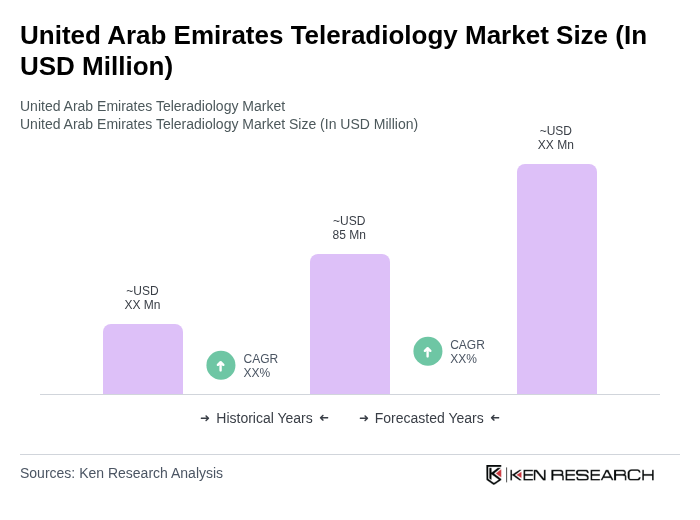
- The United Arab Emirates Teleradiology Market is valued at USD 85 million, based on a five-year historical analysis of country-level revenue data for teleradiology services. This growth is primarily driven by the increasing demand for remote healthcare services, rapid expansion of telemedicine platforms, advancements in imaging technologies such as digital radiography and cloud-based PACS, and the rising prevalence of chronic diseases that require regular imaging for monitoring and diagnosis.
- Key cities such as Dubai and Abu Dhabi dominate the market due to their advanced healthcare infrastructure, strong public and private investment in medical technology, and a large expatriate population that demands high-quality, accessible healthcare services. The presence of numerous tertiary-care hospitals, specialized imaging centers, integrated health information exchanges such as Malaffi and Nabidh, and a strategic focus on medical tourism further enhance their market position and support wider adoption of teleradiology across networks.
- In 2023, the UAE government implemented a regulatory framework aimed at enhancing the quality and accessibility of teleradiology services, building on national digital health and telemedicine policies. A key instrument is the Federal Decree-Law No. 2 of 2019 on the Use of Information and Communication Technology in Health Fields, issued by the UAE Ministry of Health and Prevention, which sets binding requirements for licensing of telehealth services, data security, cross-border data transfer, and patient privacy, including the handling and transmission of diagnostic images. In addition, emirate-level regulators such as the Dubai Health Authority and the Department of Health – Abu Dhabi have issued standards and guidelines for telehealth, mandating secure platforms, integration with electronic medical records, and adherence to international data protection and clinical quality standards for teleradiology practice.
United Arab Emirates Teleradiology Market Segmentation
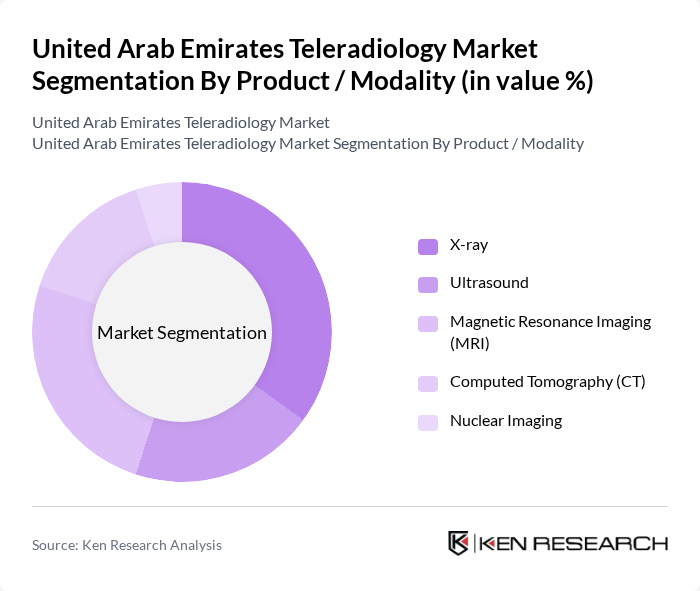
By Product / Modality:The teleradiology market is segmented into various modalities, including X-ray, Ultrasound, Magnetic Resonance Imaging (MRI), Computed Tomography (CT), and Nuclear Imaging, in line with leading market studies on the United Arab Emirates teleradiology sector. Among these, Ultrasound currently accounts for the largest revenue share in the country, while Computed Tomography is emerging as one of the most lucrative and fast-growing segments due to its critical role in emergency and oncology imaging. X-ray and MRI, however, remain widely used in teleradiology workflows because of their broad clinical applications, from musculoskeletal and chest imaging to neurology and oncology, and their compatibility with remote reporting systems. The increasing adoption of advanced imaging technologies, integration with RIS/PACS and cloud platforms, and the need for quick, round-the-clock diagnostic solutions across hospital networks and satellite clinics are driving the growth of these modalities.
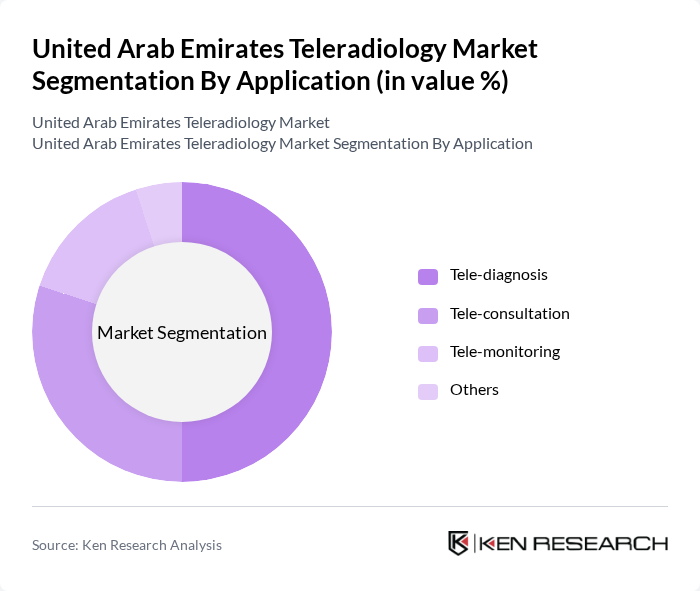
By Application:The applications of teleradiology include Tele-diagnosis, Tele-consultation, Tele-monitoring, and others, which is consistent with recognized segmentation used in United Arab Emirates teleradiology market analyses. Tele-diagnosis is the leading application, driven by the need for timely, accurate interpretation of imaging studies, especially during off-hours and for facilities in remote or underserved locations that rely on centralized radiology expertise. The increasing reliance on telehealth services, expansion of integrated health information exchanges, and growing acceptance of remote specialist consultations among providers and patients are further propelling this segment's growth and supporting the use of Tele-consultation and Tele-monitoring to coordinate multidisciplinary care.
United Arab Emirates Teleradiology Market Competitive Landscape
The United Arab Emirates Teleradiology Market is characterized by a dynamic mix of regional and international players. Leading participants such as Abu Dhabi Health Services Company (SEHA), Dubai Health Authority (DHA), Mediclinic Middle East, NMC Healthcare, Al Zahra Hospital Dubai, Emirates Healthcare Group, American Hospital Dubai, HealthPlus Network of Specialty Centers, Aster DM Healthcare, Saudi German Hospital Dubai, Burjeel Hospital, Rashid Hospital, Mediclinic City Hospital, Al Noor Hospital, Dubai London Clinic and Specialty Hospital contribute to innovation, geographic expansion, and service delivery in this space.
United Arab Emirates Teleradiology Market Industry Analysis
Growth Drivers
- Increasing Demand for Remote Diagnostics:The United Arab Emirates has seen a significant rise in the demand for remote diagnostics, driven by a population of approximately 9.5 million people. The World Health Organization reported that 60% of the population prefers remote consultations, especially in rural areas. This trend is further supported by the UAE's healthcare expenditure, which was reported at around AED 53 billion for health in the federal and emirate-level budgets, indicating a strong investment in telehealth solutions to enhance accessibility and efficiency in healthcare delivery.
- Advancements in Imaging Technology:The teleradiology market in the UAE is bolstered by rapid advancements in imaging technology, with the country investing AED 2.5 billion in medical imaging equipment. Innovations such as high-resolution imaging and portable devices have improved diagnostic accuracy and efficiency. The integration of advanced imaging technologies is expected to enhance the capabilities of healthcare providers, allowing for quicker and more reliable diagnoses, which is crucial in a region with a growing demand for specialized medical services.
- Rising Prevalence of Chronic Diseases:The UAE faces a growing burden of chronic diseases, with the Ministry of Health reporting that approximately 12–18% of the population suffers from diabetes and cardiovascular diseases. This rising prevalence necessitates increased diagnostic services, including teleradiology, to manage patient care effectively. The healthcare sector's response includes expanding teleradiology services to ensure timely diagnosis and treatment, thereby improving health outcomes and reducing the overall healthcare costs associated with chronic disease management.
Market Challenges
- Data Security and Privacy Concerns:Data security remains a significant challenge in the UAE's teleradiology market, with the Cybersecurity Council reporting over 1,200 cyber incidents. The sensitive nature of medical data requires stringent security measures, and healthcare providers face challenges in ensuring compliance with data protection regulations. The potential for data breaches can undermine patient trust and deter the adoption of teleradiology services, necessitating robust cybersecurity frameworks to protect patient information.
- High Initial Investment Costs:The initial investment required for teleradiology infrastructure can be a barrier for many healthcare providers in the UAE. The cost of advanced imaging equipment and telecommunication technologies can exceed AED 1 million for small to medium-sized facilities. This financial burden may limit the ability of these providers to adopt teleradiology solutions, thereby restricting access to remote diagnostic services, particularly in underserved areas where such services are most needed.
United Arab Emirates Teleradiology Market Future Outlook
The future of the teleradiology market in the UAE appears promising, driven by technological advancements and increasing healthcare demands. As the government continues to invest in healthcare infrastructure, the integration of artificial intelligence and cloud-based solutions is expected to enhance diagnostic capabilities. Additionally, the growing emphasis on patient-centric care models will likely lead to more personalized and efficient healthcare delivery, positioning teleradiology as a vital component of the UAE's healthcare landscape in future.
Market Opportunities
- Expansion of Telehealth Services:The expansion of telehealth services presents a significant opportunity for teleradiology in the UAE. With the government aiming to increase telehealth consultations by 40% in future, teleradiology can play a crucial role in providing remote diagnostic services, thereby improving healthcare access and efficiency across the nation.
- Integration of AI in Radiology:The integration of artificial intelligence in radiology offers substantial growth potential. AI technologies can enhance image analysis and diagnostic accuracy, reducing the workload on radiologists. The UAE's investment in AI is projected to reach AED 1 billion in future, creating a fertile environment for innovative teleradiology solutions that leverage AI capabilities to improve patient outcomes.
Scope of the Report
| Segment | Sub-Segments |
|---|---|
| By Product / Modality | X-ray Ultrasound Magnetic Resonance Imaging (MRI) Computed Tomography (CT) Nuclear Imaging |
| By Application | Tele-diagnosis Tele-consultation Tele-monitoring Others |
| By Service Delivery Model | Cloud-based Teleradiology Web-based Teleradiology On-premises Teleradiology Hybrid Models |
| By End-User | Hospitals Diagnostic Imaging Centers Ambulatory Surgical Centers Others |
| By Type of Reading | Primary Reading Second Opinion / Over-read Subspecialty Reading (e.g., neuroradiology, musculoskeletal) Emergency / Night Hawk Services |
| By Healthcare Setting | Public Sector Facilities Private Sector Facilities Specialty Clinics Others |
| By Emirate | Abu Dhabi Dubai Sharjah Other Emirates |
Key Target Audience
Investors and Venture Capitalist Firms
Government and Regulatory Bodies (e.g., Ministry of Health and Prevention, Dubai Health Authority)
Healthcare Providers and Hospitals
Radiology Service Providers
Telecommunication Companies
Health Insurance Companies
Medical Equipment Manufacturers
Healthcare IT Solution Providers
Players Mentioned in the Report:
Abu Dhabi Health Services Company (SEHA)
Dubai Health Authority (DHA)
Mediclinic Middle East
NMC Healthcare
Al Zahra Hospital Dubai
Emirates Healthcare Group
American Hospital Dubai
HealthPlus Network of Specialty Centers
Aster DM Healthcare
Saudi German Hospital Dubai
Burjeel Hospital
Rashid Hospital
Mediclinic City Hospital
Al Noor Hospital
Dubai London Clinic and Specialty Hospital
Table of Contents
Market Assessment Phase
1. Executive Summary and Approach
2. United Arab Emirates Teleradiology Market Overview
2.1 Key Insights and Strategic Recommendations
2.2 United Arab Emirates Teleradiology Market Overview
2.3 Definition and Scope
2.4 Evolution of Market Ecosystem
2.5 Timeline of Key Regulatory Milestones
2.6 Value Chain & Stakeholder Mapping
2.7 Business Cycle Analysis
2.8 Policy & Incentive Landscape
3. United Arab Emirates Teleradiology Market Analysis
3.1 Growth Drivers
3.1.1 Increasing demand for remote diagnostics
3.1.2 Advancements in imaging technology
3.1.3 Rising prevalence of chronic diseases
3.1.4 Government initiatives to enhance healthcare access
3.2 Market Challenges
3.2.1 Data security and privacy concerns
3.2.2 High initial investment costs
3.2.3 Limited awareness among healthcare providers
3.2.4 Regulatory compliance complexities
3.3 Market Opportunities
3.3.1 Expansion of telehealth services
3.3.2 Integration of AI in radiology
3.3.3 Partnerships with healthcare institutions
3.3.4 Development of mobile teleradiology solutions
3.4 Market Trends
3.4.1 Increased adoption of cloud-based solutions
3.4.2 Growth in patient-centric care models
3.4.3 Rise of value-based healthcare
3.4.4 Focus on interoperability among systems
3.5 Government Regulation
3.5.1 Licensing requirements for teleradiology services
3.5.2 Standards for data protection and patient privacy
3.5.3 Guidelines for telemedicine practices
3.5.4 Reimbursement policies for teleradiology services
4. SWOT Analysis
5. Stakeholder Analysis
6. Porter's Five Forces Analysis
7. United Arab Emirates Teleradiology Market Market Size, 2019-2024
7.1 By Value
7.2 By Volume
7.3 By Average Selling Price
8. United Arab Emirates Teleradiology Market Segmentation
8.1 By Product / Modality
8.1.1 X-ray
8.1.2 Ultrasound
8.1.3 Magnetic Resonance Imaging (MRI)
8.1.4 Computed Tomography (CT)
8.1.5 Nuclear Imaging
8.2 By Application
8.2.1 Tele-diagnosis
8.2.2 Tele-consultation
8.2.3 Tele-monitoring
8.2.4 Others
8.3 By Service Delivery Model
8.3.1 Cloud-based Teleradiology
8.3.2 Web-based Teleradiology
8.3.3 On-premises Teleradiology
8.3.4 Hybrid Models
8.4 By End-User
8.4.1 Hospitals
8.4.2 Diagnostic Imaging Centers
8.4.3 Ambulatory Surgical Centers
8.4.4 Others
8.5 By Type of Reading
8.5.1 Primary Reading
8.5.2 Second Opinion / Over-read
8.5.3 Subspecialty Reading (e.g., neuroradiology, musculoskeletal)
8.5.4 Emergency / Night Hawk Services
8.6 By Healthcare Setting
8.6.1 Public Sector Facilities
8.6.2 Private Sector Facilities
8.6.3 Specialty Clinics
8.6.4 Others
8.7 By Emirate
8.7.1 Abu Dhabi
8.7.2 Dubai
8.7.3 Sharjah
8.7.4 Other Emirates
9. United Arab Emirates Teleradiology Market Competitive Analysis
9.1 Market Share of Key Players
9.2 Cross Comparison of Key Players
9.2.1 Company Name
9.2.2 Group Size (Large, Medium, or Small as per industry convention)
9.2.3 UAE Teleradiology Revenue (Latest Year, USD Million)
9.2.4 3-year Revenue CAGR in UAE Teleradiology (%)
9.2.5 Share of Teleradiology in Total Company Healthcare Revenue (%)
9.2.6 Number of Partner Sites / Facilities Covered in UAE
9.2.7 Annual Exam Volume Reported (Number of Studies per Year)
9.2.8 Average Turnaround Time for Reports (Minutes / Hours)
9.2.9 Service Mix (Emergency vs Routine vs Subspecialty, % of Volume)
9.2.10 Average Revenue per Study (USD)
9.2.11 Gross Margin from Teleradiology Services (%)
9.2.12 Technology Maturity (Cloud / AI / PACS-RIS Integration Score)
9.2.13 Contract Retention / Renewal Rate (%)
9.2.14 Net Promoter Score (NPS) / Customer Satisfaction Index
9.3 SWOT Analysis of Top Players
9.4 Pricing Analysis
9.5 Detailed Profile of Major Companies
9.5.1 Abu Dhabi Health Services Company (SEHA)
9.5.2 Dubai Health Authority (DHA)
9.5.3 Mediclinic Middle East
9.5.4 NMC Healthcare
9.5.5 Al Zahra Hospital Dubai
9.5.6 Emirates Healthcare Group
9.5.7 American Hospital Dubai
9.5.8 HealthPlus Network of Specialty Centers
9.5.9 Aster DM Healthcare
9.5.10 Saudi German Hospital Dubai
9.5.11 Burjeel Hospital
9.5.12 Rashid Hospital
9.5.13 Mediclinic City Hospital
9.5.14 Al Noor Hospital
9.5.15 Dubai London Clinic and Specialty Hospital
10. United Arab Emirates Teleradiology Market End-User Analysis
10.1 Procurement Behavior of Key Ministries
10.1.1 Ministry of Health and Prevention
10.1.2 Ministry of Interior
10.1.3 Ministry of Education
10.1.4 Others
10.2 Corporate Spend on Infrastructure & Energy
10.2.1 Healthcare Infrastructure Investments
10.2.2 Technology Upgrades
10.2.3 Training and Development
10.2.4 Others
10.3 Pain Point Analysis by End-User Category
10.3.1 Hospitals
10.3.2 Diagnostic Centers
10.3.3 Research Institutions
10.3.4 Others
10.4 User Readiness for Adoption
10.4.1 Awareness Levels
10.4.2 Training Needs
10.4.3 Infrastructure Readiness
10.4.4 Others
10.5 Post-Deployment ROI and Use Case Expansion
10.5.1 Cost Savings Analysis
10.5.2 Service Expansion Opportunities
10.5.3 User Feedback Mechanisms
10.5.4 Others
11. United Arab Emirates Teleradiology Market Future Size, 2025-2030
11.1 By Value
11.2 By Volume
11.3 By Average Selling Price
Go-To-Market Strategy Phase
1. Whitespace Analysis + Business Model Canvas
1.1 Market Gaps Identification
1.2 Business Model Development
2. Marketing and Positioning Recommendations
2.1 Branding Strategies
2.2 Product USPs
3. Distribution Plan
3.1 Urban Retail vs Rural NGO Tie-ups
4. Channel & Pricing Gaps
4.1 Underserved Routes
4.2 Pricing Bands
5. Unmet Demand & Latent Needs
5.1 Category Gaps
5.2 Consumer Segments
6. Customer Relationship
6.1 Loyalty Programs
6.2 After-sales Service
7. Value Proposition
7.1 Sustainability
7.2 Integrated Supply Chains
8. Key Activities
8.1 Regulatory Compliance
8.2 Branding
8.3 Distribution Setup
9. Entry Strategy Evaluation
9.1 Domestic Market Entry Strategy
9.1.1 Product Mix
9.1.2 Pricing Band
9.1.3 Packaging
9.2 Export Entry Strategy
9.2.1 Target Countries
9.2.2 Compliance Roadmap
10. Entry Mode Assessment
10.1 JV
10.2 Greenfield
10.3 M&A
10.4 Distributor Model
11. Capital and Timeline Estimation
11.1 Capital Requirements
11.2 Timelines
12. Control vs Risk Trade-Off
12.1 Ownership vs Partnerships
13. Profitability Outlook
13.1 Breakeven Analysis
13.2 Long-term Sustainability
14. Potential Partner List
14.1 Distributors
14.2 JVs
14.3 Acquisition Targets
15. Execution Roadmap
15.1 Phased Plan for Market Entry
15.1.1 Market Setup
15.1.2 Market Entry
15.1.3 Growth Acceleration
15.1.4 Scale & Stabilize
15.2 Key Activities and Milestones
15.2.1 Activity Planning
15.2.2 Milestone Tracking
Research Methodology
Phase 1: Approach1
Desk Research
- Analysis of industry reports from healthcare organizations and government health departments in the UAE
- Review of published articles and white papers on teleradiology trends and technologies
- Examination of market statistics from relevant healthcare associations and international health organizations
Primary Research
- Interviews with radiologists and healthcare administrators in leading hospitals and clinics
- Telephonic surveys with teleradiology service providers and technology vendors
- Field interviews with IT managers overseeing radiology departments in healthcare facilities
Validation & Triangulation
- Cross-validation of findings through multiple data sources, including market reports and expert opinions
- Triangulation of data from primary interviews and secondary research to ensure consistency
- Sanity checks through expert panel reviews comprising industry veterans and academic professionals
Phase 2: Market Size Estimation1
Top-down Assessment
- Estimation of the teleradiology market size based on national healthcare expenditure and radiology service utilization rates
- Segmentation of the market by service type, including remote consultations and diagnostic imaging services
- Incorporation of government initiatives promoting telehealth and digital health solutions
Bottom-up Modeling
- Collection of firm-level data from leading teleradiology providers regarding service volumes and pricing
- Operational cost analysis based on technology investments and service delivery models
- Volume x cost calculations to derive revenue estimates for various teleradiology services
Forecasting & Scenario Analysis
- Multi-factor regression analysis considering factors such as population growth, healthcare access, and technology adoption rates
- Scenario modeling based on potential regulatory changes and shifts in healthcare delivery models
- Development of baseline, optimistic, and pessimistic forecasts through 2030
Phase 3: CATI Sample Composition1
| Scope Item/Segment | Sample Size | Target Respondent Profiles |
|---|---|---|
| Hospital Radiology Departments | 60 | Radiologists, Department Heads |
| Teleradiology Service Providers | 50 | Business Development Managers, Technical Leads |
| Healthcare IT Solutions | 40 | IT Managers, System Administrators |
| Insurance Companies Offering Telehealth | 40 | Policy Analysts, Claims Managers |
| Regulatory Bodies in Healthcare | 40 | Policy Makers, Compliance Officers |
Frequently Asked Questions
What is the current value of the United Arab Emirates Teleradiology Market?
The United Arab Emirates Teleradiology Market is valued at approximately USD 85 million, reflecting a significant growth trend driven by increasing demand for remote healthcare services and advancements in imaging technologies.
What factors are driving the growth of the teleradiology market in the UAE?
Which cities in the UAE are leading in the teleradiology market?
What regulatory framework governs teleradiology services in the UAE?
Other Regional/Country Reports
Other Adjacent Reports
Brazil Diagnostic Imaging Market
South Africa Radiology Services Market
KSA Artificial Intelligence in Healthcare Market Size, Share & Forecast, By Solution Type, Deployment Model & Application, 2026-2031United States Cloud Computing in Healthcare Market Outlook to 2030: Size, Share, Growth and TrendsKuwait Health Information Exchange Market
Middle East Chronic Disease Management Market Size, Share, Growth Drivers, Trends, Opportunities & Forecast 2025–2030Philippines Medical Tourism Market Size, Share & Forecast, By Service Type, Care Setting & Customer Type, 2026–2032Why Buy From Us?

What makes us stand out is that our consultants follow Robust, Refine and Result (RRR) methodology. Robust for clear definitions, approaches and sanity checking, Refine for differentiating respondents' facts and opinions, and Result for presenting data with story.

We have set a benchmark in the industry by offering our clients with syndicated and customized market research reports featuring coverage of entire market as well as meticulous research and analyst insights.

While we don't replace traditional research, we flip the method upside down. Our dual approach of Top Bottom & Bottom Top ensures quality deliverable by not just verifying company fundamentals but also looking at the sector and macroeconomic factors.

With one step in the future, our research team constantly tries to show you the bigger picture. We help with some of the tough questions you may encounter along the way: How is the industry positioned? Best marketing channel? KPI's of competitors? By aligning every element, we help maximize success.

Our report gives you instant access to the answers and sources that other companies might choose to hide. We elaborate each steps of research methodology we have used and showcase you the sample size to earn your trust.

If you need any support, we are here! We pride ourselves on universe strength, data quality, and quick, friendly, and professional service.