About the Report
Base Year 2024Listen to the audio summary
Indonesia Teleradiology Market Overview
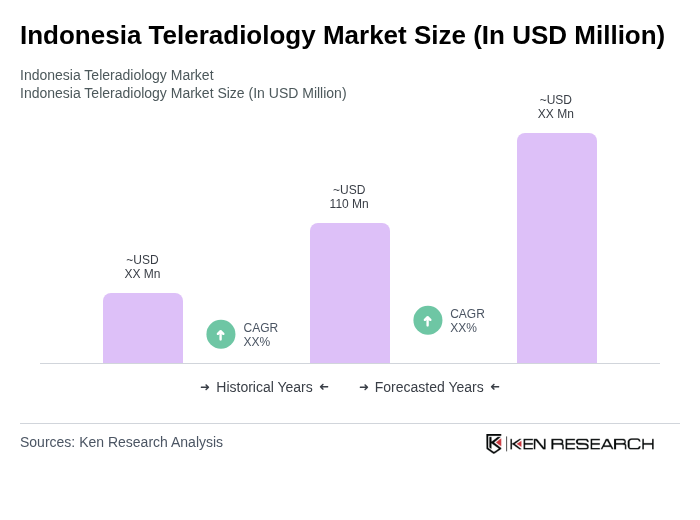
- The Indonesia Teleradiology Market is valued at USD 110 million, based on a five-year historical analysis and benchmarking against the size of the broader Indonesia medical imaging and connected healthcare markets. This growth is primarily driven by the increasing demand for remote healthcare services, rapid expansion of telemedicine platforms, advancements in imaging technology, and the rising prevalence of chronic diseases such as cardiovascular disorders, cancer, and diabetes. The integration of telemedicine with teleradiology, supported by improved broadband and 4G/5G connectivity, has further accelerated the adoption of these services, enabling timely diagnosis, remote reporting, and specialist access across the archipelago, including underserved regions.
- Key cities such as Jakarta, Surabaya, and Bandung dominate the market due to their advanced healthcare infrastructure, higher population density, and concentration of tertiary hospitals and diagnostic imaging centers. These urban centers host a greater number of CT, MRI, and digital X-ray installations, which facilitates the demand for teleradiology services to manage high imaging volumes and after-hours reporting. Additionally, the presence of skilled radiologists, sub-specialty experts, and technology-driven telemedicine companies in these regions supports market growth by enabling faster turnaround times and better access to second opinions.
- In 2023, the Indonesian government strengthened the regulatory basis for telemedicine and remote diagnostic services through the Minister of Health Regulation No. 24 of 2022 on Medical Records, issued by the Ministry of Health, which formally recognizes electronic medical records, supports the use of telemedicine platforms, and sets requirements for data security, interoperability, and documentation of remote diagnostic services including imaging. This framework, together with earlier telemedicine and health service digitalization initiatives, aims to enhance access to medical imaging and diagnostic services in remote areas, ensure patient safety and confidentiality, and support more integrated referral pathways. The initiative is part of a broader national strategy to improve healthcare delivery, expand digital health, and reduce disparities in access to medical services across the country.
Indonesia Teleradiology Market Segmentation
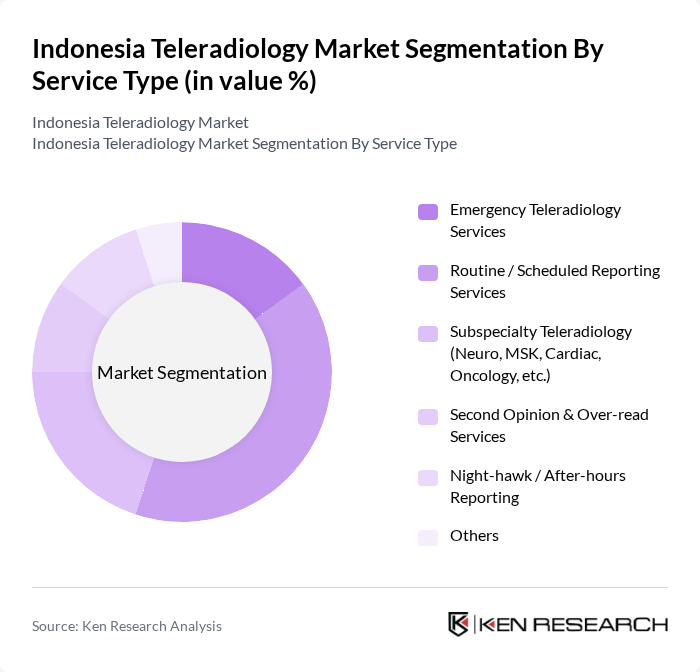
By Service Type:The service type segmentation includes various categories such as Emergency Teleradiology Services, Routine / Scheduled Reporting Services, Subspecialty Teleradiology (Neuro, MSK, Cardiac, Oncology, etc.), Second Opinion & Over-read Services, Night-hawk / After-hours Reporting, and Others. Routine / Scheduled Reporting Services is the leading sub-segment due to the consistent demand for regular imaging services in hospitals and clinics and the need to clear daily reporting backlogs for high-volume modalities like X-ray and CT. The increasing reliance on timely and accurate reporting for patient management, hospital quality metrics, and integrated electronic medical record workflows has solidified its position in the market.
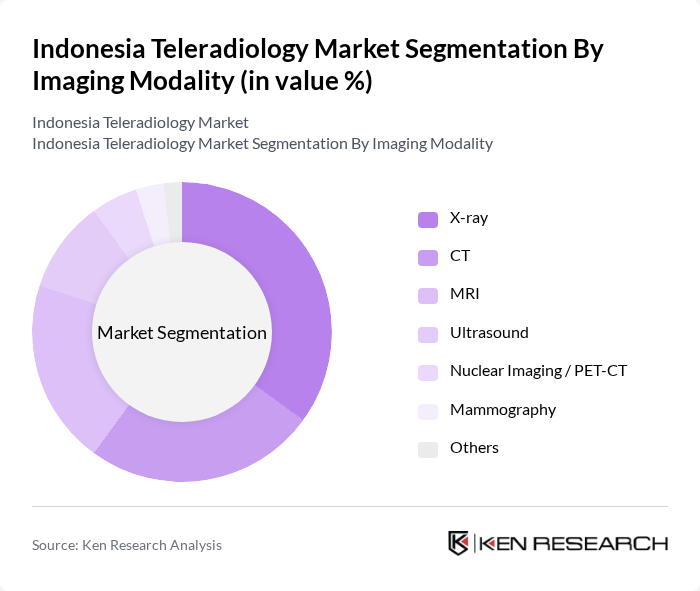
By Imaging Modality:The imaging modality segmentation encompasses X-ray, CT, MRI, Ultrasound, Nuclear Imaging / PET-CT, Mammography, and Others. The X-ray modality is the most dominant due to its widespread use as a first-line diagnostic tool in public and private healthcare facilities, including primary care centers and district hospitals. Its relatively low cost, high throughput, and the ability to digitize and transmit images quickly make it a preferred choice among healthcare providers, thereby driving its share in teleradiology workloads, particularly for chest, musculoskeletal, and emergency imaging.
Indonesia Teleradiology Market Competitive Landscape
The Indonesia Teleradiology Market is characterized by a dynamic mix of regional and international players. Leading participants such as Halodoc, Alodokter, KlikDokter, ProSehat, Medigo Indonesia, Teleradiology Solutions, Telemedicine Clinic (PT Global Telemedika), Global Diagnostics, 3D Global Telemedicine Indonesia, Qure.ai, Telerad Tech, Siemens Healthineers, GE HealthCare, Philips Healthcare, and Fujifilm Indonesia contribute to innovation, geographic expansion, and service delivery in this space.
Indonesia Teleradiology Market Industry Analysis
Growth Drivers
- Increasing Demand for Remote Diagnostics:The Indonesian healthcare system is witnessing a surge in demand for remote diagnostics, driven by a population of over 270 million. In future, the telehealth market is projected to reach $1 billion, reflecting a 20% increase from prior periods. This growth is fueled by the need for accessible healthcare services, especially in remote areas where traditional healthcare facilities are limited. The COVID-19 pandemic has further accelerated this trend, highlighting the importance of remote diagnostic capabilities.
- Advancements in Imaging Technology:The teleradiology market in Indonesia is benefiting from significant advancements in imaging technology, with the country expected to invest approximately $500 million in medical imaging equipment in future. Innovations such as high-resolution imaging and cloud-based storage solutions are enhancing diagnostic accuracy and efficiency. These technological improvements are crucial for radiologists, enabling them to provide timely and precise diagnoses, thereby increasing the overall demand for teleradiology services across the nation.
- Rising Healthcare Expenditure:Indonesia's healthcare expenditure is projected to reach $50 billion in future, up from $40 billion in prior periods, indicating a robust growth trajectory. This increase is driven by government initiatives aimed at improving healthcare access and quality. As more funds are allocated to healthcare, investments in teleradiology services are expected to rise, facilitating better diagnostic services and ultimately improving patient outcomes across the archipelago, particularly in underserved regions.
Market Challenges
- Data Privacy and Security Concerns:The teleradiology market faces significant challenges related to data privacy and security, particularly as Indonesia's healthcare sector transitions to digital platforms. In future, the country is expected to see a 30% increase in cyberattacks targeting healthcare data. This raises concerns about patient confidentiality and compliance with regulations, which could hinder the adoption of teleradiology services and deter potential investors from entering the market.
- Limited Internet Connectivity in Rural Areas:Approximately 40% of Indonesia's rural population lacks reliable internet access, which poses a significant barrier to the growth of teleradiology services. In future, the government aims to improve internet connectivity, but current infrastructure challenges remain. This digital divide limits the ability of healthcare providers in remote areas to utilize teleradiology effectively, thereby restricting the overall market potential and accessibility of diagnostic services.
Indonesia Teleradiology Market Future Outlook
The future of the teleradiology market in Indonesia appears promising, driven by technological advancements and increasing healthcare investments. As the government continues to enhance healthcare infrastructure and internet connectivity, the adoption of teleradiology services is expected to rise significantly. Additionally, the integration of artificial intelligence in diagnostic processes will likely improve efficiency and accuracy, making teleradiology an essential component of Indonesia's healthcare landscape. This evolution will ultimately lead to better patient outcomes and expanded access to medical services.
Market Opportunities
- Growth in Telemedicine Adoption:The increasing acceptance of telemedicine presents a significant opportunity for teleradiology services. With an estimated 15 million telemedicine consultations expected in future, teleradiology can play a crucial role in providing timely diagnostic support, enhancing patient care, and streamlining healthcare delivery across Indonesia's diverse regions.
- Partnerships with Local Healthcare Providers:Collaborating with local healthcare providers can create substantial opportunities for teleradiology firms. By forming strategic alliances, companies can leverage existing networks and resources, facilitating the integration of teleradiology services into local practices. This approach can enhance service delivery and expand market reach, particularly in underserved areas where access to radiology services is limited.
Scope of the Report
| Segment | Sub-Segments |
|---|---|
| By Service Type | Emergency Teleradiology Services Routine / Scheduled Reporting Services Subspecialty Teleradiology (Neuro, MSK, Cardiac, Oncology, etc.) Second Opinion & Over?read Services Night?hawk / After?hours Reporting Others |
| By Imaging Modality | X?ray CT MRI Ultrasound Nuclear Imaging / PET?CT Mammography Others |
| By End-User | Public Hospitals Private Hospitals Diagnostic Imaging Centers Telemedicine Platforms & Virtual Clinics Primary Care / Community Health Facilities (Puskesmas, Clinics) Others |
| By Delivery Model | Cloud-based Teleradiology Platforms Web-based / PACS-integrated Solutions Hybrid (On-premise + Cloud) Models AI-assisted Reporting Platforms Others |
| By Geography (Within Indonesia) | Java & Bali Sumatra Kalimantan Sulawesi Papua & Maluku Others |
| By Client Type | Single-site Facilities Multi-site Hospital Networks Diagnostic Chains Public Sector / Government Programs Others |
Key Target Audience
Investors and Venture Capitalist Firms
Government and Regulatory Bodies (e.g., Ministry of Health, National Health Insurance Agency)
Healthcare Providers and Hospitals
Radiology Service Providers
Telecommunication Companies
Health Insurance Companies
Medical Equipment Manufacturers
Healthcare Technology Startups
Players Mentioned in the Report:
Halodoc
Alodokter
KlikDokter
ProSehat
Medigo Indonesia
Teleradiology Solutions
Telemedicine Clinic (PT Global Telemedika)
Global Diagnostics
3D Global Telemedicine Indonesia
Qure.ai
Telerad Tech
Siemens Healthineers
GE HealthCare
Philips Healthcare
Fujifilm Indonesia
Table of Contents
Market Assessment Phase
1. Executive Summary and Approach
2. Indonesia Teleradiology Market Overview
2.1 Key Insights and Strategic Recommendations
2.2 Indonesia Teleradiology Market Overview
2.3 Definition and Scope
2.4 Evolution of Market Ecosystem
2.5 Timeline of Key Regulatory Milestones
2.6 Value Chain & Stakeholder Mapping
2.7 Business Cycle Analysis
2.8 Policy & Incentive Landscape
3. Indonesia Teleradiology Market Analysis
3.1 Growth Drivers
3.1.1 Increasing demand for remote diagnostics
3.1.2 Advancements in imaging technology
3.1.3 Rising healthcare expenditure
3.1.4 Expansion of healthcare infrastructure
3.2 Market Challenges
3.2.1 Data privacy and security concerns
3.2.2 Limited internet connectivity in rural areas
3.2.3 Regulatory compliance issues
3.2.4 Shortage of trained radiologists
3.3 Market Opportunities
3.3.1 Growth in telemedicine adoption
3.3.2 Partnerships with local healthcare providers
3.3.3 Development of AI-driven diagnostic tools
3.3.4 Expansion into underserved regions
3.4 Market Trends
3.4.1 Increasing integration of AI in radiology
3.4.2 Shift towards value-based care
3.4.3 Rise of mobile health applications
3.4.4 Growing focus on patient-centered care
3.5 Government Regulation
3.5.1 Implementation of telehealth regulations
3.5.2 Licensing requirements for teleradiology services
3.5.3 Standards for data protection and privacy
3.5.4 Incentives for technology adoption in healthcare
4. SWOT Analysis
5. Stakeholder Analysis
6. Porter's Five Forces Analysis
7. Indonesia Teleradiology Market Market Size, 2019-2024
7.1 By Value
7.2 By Volume
7.3 By Average Selling Price
8. Indonesia Teleradiology Market Segmentation
8.1 By Service Type
8.1.1 Emergency Teleradiology Services
8.1.2 Routine / Scheduled Reporting Services
8.1.3 Subspecialty Teleradiology (Neuro, MSK, Cardiac, Oncology, etc.)
8.1.4 Second Opinion & Over?read Services
8.1.5 Night?hawk / After?hours Reporting
8.1.6 Others
8.2 By Imaging Modality
8.2.1 X?ray
8.2.2 CT
8.2.3 MRI
8.2.4 Ultrasound
8.2.5 Nuclear Imaging / PET?CT
8.2.6 Mammography
8.2.7 Others
8.3 By End-User
8.3.1 Public Hospitals
8.3.2 Private Hospitals
8.3.3 Diagnostic Imaging Centers
8.3.4 Telemedicine Platforms & Virtual Clinics
8.3.5 Primary Care / Community Health Facilities (Puskesmas, Clinics)
8.3.6 Others
8.4 By Delivery Model
8.4.1 Cloud-based Teleradiology Platforms
8.4.2 Web-based / PACS-integrated Solutions
8.4.3 Hybrid (On-premise + Cloud) Models
8.4.4 AI-assisted Reporting Platforms
8.4.5 Others
8.5 By Geography (Within Indonesia)
8.5.1 Java & Bali
8.5.2 Sumatra
8.5.3 Kalimantan
8.5.4 Sulawesi
8.5.5 Papua & Maluku
8.5.6 Others
8.6 By Client Type
8.6.1 Single-site Facilities
8.6.2 Multi-site Hospital Networks
8.6.3 Diagnostic Chains
8.6.4 Public Sector / Government Programs
8.6.5 Others
9. Indonesia Teleradiology Market Competitive Analysis
9.1 Market Share of Key Players
9.2 Cross Comparison of Key Players
9.2.1 Company Name
9.2.2 Ownership & Group Size (Local SME, Regional Player, Global MNC)
9.2.3 Indonesia Teleradiology Revenue (Latest Year, USD Million)
9.2.4 3–5 Year Revenue CAGR in Indonesia (%)
9.2.5 Number of Studies Reported per Day (Average Volume)
9.2.6 Number of Contracted Facilities (Hospitals / Centers)
9.2.7 Average Turnaround Time (TAT) for Stat / Routine Cases
9.2.8 Share of Revenue from Indonesia vs. Global (%)
9.2.9 EBITDA Margin (%) for Indonesia Operations
9.2.10 Average Contract Tenure (Years)
9.2.11 Pricing Positioning (Premium / Mid / Value)
9.2.12 Technology Maturity (Cloud, AI, PACS integration scorecard)
9.2.13 Service Level Agreement (SLA) Adherence Rate (%)
9.2.14 Customer Retention / Renewal Rate (%)
9.2.15 Compliance & Accreditation (ISO, HIPAA-equivalent, Local)
9.3 SWOT Analysis of Top Players
9.4 Pricing Analysis
9.5 Detailed Profile of Major Companies
9.5.1 Halodoc
9.5.2 Alodokter
9.5.3 KlikDokter
9.5.4 ProSehat
9.5.5 Medigo Indonesia
9.5.6 Teleradiology Solutions
9.5.7 Telemedicine Clinic (PT Global Telemedika)
9.5.8 Global Diagnostics
9.5.9 3D Global Telemedicine Indonesia
9.5.10 Qure.ai
9.5.11 Telerad Tech
9.5.12 Siemens Healthineers
9.5.13 GE HealthCare
9.5.14 Philips Healthcare
9.5.15 Fujifilm Indonesia
10. Indonesia Teleradiology Market End-User Analysis
10.1 Procurement Behavior of Key Ministries
10.1.1 Budget Allocation for Teleradiology
10.1.2 Decision-Making Process
10.1.3 Preferred Vendors
10.1.4 Contract Duration
10.2 Corporate Spend on Infrastructure & Energy
10.2.1 Investment in Teleradiology Infrastructure
10.2.2 Spending Trends
10.2.3 Budget Constraints
10.2.4 Future Projections
10.3 Pain Point Analysis by End-User Category
10.3.1 Challenges Faced by Hospitals
10.3.2 Issues in Diagnostic Centers
10.3.3 Concerns of Research Institutions
10.3.4 Others
10.4 User Readiness for Adoption
10.4.1 Training Needs
10.4.2 Technology Familiarity
10.4.3 Infrastructure Readiness
10.4.4 Others
10.5 Post-Deployment ROI and Use Case Expansion
10.5.1 Measurement of ROI
10.5.2 Use Case Success Stories
10.5.3 Future Expansion Plans
10.5.4 Others
11. Indonesia Teleradiology Market Future Size, 2025-2030
11.1 By Value
11.2 By Volume
11.3 By Average Selling Price
Go-To-Market Strategy Phase
1. Whitespace Analysis + Business Model Canvas
1.1 Market Gaps Identification
1.2 Business Model Development
2. Marketing and Positioning Recommendations
2.1 Branding Strategies
2.2 Product USPs
3. Distribution Plan
3.1 Urban Retail Strategies
3.2 Rural NGO Tie-Ups
4. Channel & Pricing Gaps
4.1 Underserved Routes
4.2 Pricing Bands
5. Unmet Demand & Latent Needs
5.1 Category Gaps
5.2 Consumer Segments
6. Customer Relationship
6.1 Loyalty Programs
6.2 After-Sales Service
7. Value Proposition
7.1 Sustainability
7.2 Integrated Supply Chains
8. Key Activities
8.1 Regulatory Compliance
8.2 Branding
8.3 Distribution Setup
9. Entry Strategy Evaluation
9.1 Domestic Market Entry Strategy
9.1.1 Product Mix
9.1.2 Pricing Band
9.1.3 Packaging
9.2 Export Entry Strategy
9.2.1 Target Countries
9.2.2 Compliance Roadmap
10. Entry Mode Assessment
10.1 Joint Ventures
10.2 Greenfield Investments
10.3 Mergers & Acquisitions
10.4 Distributor Model
11. Capital and Timeline Estimation
11.1 Capital Requirements
11.2 Timelines
12. Control vs Risk Trade-Off
12.1 Ownership vs Partnerships
13. Profitability Outlook
13.1 Breakeven Analysis
13.2 Long-Term Sustainability
14. Potential Partner List
14.1 Distributors
14.2 Joint Ventures
14.3 Acquisition Targets
15. Execution Roadmap
15.1 Phased Plan for Market Entry
15.1.1 Market Setup
15.1.2 Market Entry
15.1.3 Growth Acceleration
15.1.4 Scale & Stabilize
15.2 Key Activities and Milestones
15.2.1 Milestone Planning
15.2.2 Activity Tracking
Research Methodology
Phase 1: Approach1
Desk Research
- Analysis of government health statistics and telemedicine regulations in Indonesia
- Review of industry reports from healthcare organizations and telehealth associations
- Examination of academic journals and publications on teleradiology advancements and trends
Primary Research
- Interviews with radiologists and healthcare professionals utilizing teleradiology services
- Surveys with hospital administrators regarding teleradiology adoption and usage
- Focus groups with patients to understand perceptions and experiences with teleradiology
Validation & Triangulation
- Cross-validation of findings through multiple data sources, including market reports and expert opinions
- Triangulation of qualitative insights from interviews with quantitative data from surveys
- Sanity checks through expert panel reviews comprising industry veterans and academic researchers
Phase 2: Market Size Estimation1
Top-down Assessment
- Estimation of the overall healthcare expenditure in Indonesia and its allocation to radiology services
- Analysis of the growth rate of telemedicine and its impact on teleradiology market size
- Incorporation of demographic trends and urbanization rates affecting healthcare access
Bottom-up Modeling
- Collection of data on the number of hospitals and clinics offering teleradiology services
- Estimation of service pricing based on current market rates for teleradiology consultations
- Volume estimates based on patient throughput and frequency of teleradiology services used
Forecasting & Scenario Analysis
- Multi-factor regression analysis incorporating technological advancements and regulatory changes
- Scenario modeling based on potential market disruptions, such as pandemics or policy shifts
- Development of baseline, optimistic, and pessimistic forecasts through 2030
Phase 3: CATI Sample Composition1
| Scope Item/Segment | Sample Size | Target Respondent Profiles |
|---|---|---|
| Hospital Teleradiology Services | 100 | Radiologists, Hospital Administrators |
| Private Clinic Teleradiology Adoption | 80 | Clinic Owners, General Practitioners |
| Patient Experience with Teleradiology | 120 | Patients who have used teleradiology services |
| Regulatory Impact on Teleradiology | 60 | Healthcare Policy Makers, Legal Advisors |
| Technological Adoption in Teleradiology | 70 | IT Managers, Health Tech Innovators |
Frequently Asked Questions
What is the current value of the Indonesia Teleradiology Market?
The Indonesia Teleradiology Market is valued at approximately USD 110 million, reflecting significant growth driven by the increasing demand for remote healthcare services and advancements in imaging technology.
What factors are driving the growth of the Teleradiology Market in Indonesia?
Which cities are leading in the Teleradiology Market in Indonesia?
What are the main service types offered in the Indonesia Teleradiology Market?
Other Regional/Country Reports
Other Adjacent Reports
Indonesia Connected Healthcare Market
Qatar Digital Health Market Size, Share & Forecast, By Product Type, Care Setting & Technology, 2026-2032India Healthcare IT Market Size, Share & Forecast, By Solution Type, Deployment Model & Customer Type, 2025-2032KSA Diagnostic Imaging Market
Malaysia Radiology Services Market
UAE Electronic Medical Records MarketGCC AI in Healthcare Market Size, Share & Forecast, By Solution Type, Application & Care Setting, 2026-2031UAE Remote Patient Monitoring Market Size, Share, Growth Drivers, Trends, Opportunities & Forecast 2025–2030Why Buy From Us?

What makes us stand out is that our consultants follow Robust, Refine and Result (RRR) methodology. Robust for clear definitions, approaches and sanity checking, Refine for differentiating respondents' facts and opinions, and Result for presenting data with story.

We have set a benchmark in the industry by offering our clients with syndicated and customized market research reports featuring coverage of entire market as well as meticulous research and analyst insights.

While we don't replace traditional research, we flip the method upside down. Our dual approach of Top Bottom & Bottom Top ensures quality deliverable by not just verifying company fundamentals but also looking at the sector and macroeconomic factors.

With one step in the future, our research team constantly tries to show you the bigger picture. We help with some of the tough questions you may encounter along the way: How is the industry positioned? Best marketing channel? KPI's of competitors? By aligning every element, we help maximize success.

Our report gives you instant access to the answers and sources that other companies might choose to hide. We elaborate each steps of research methodology we have used and showcase you the sample size to earn your trust.

If you need any support, we are here! We pride ourselves on universe strength, data quality, and quick, friendly, and professional service.