About the Report
Base Year 2024Listen to the audio summary
Thailand Freight Trucking Market Overview
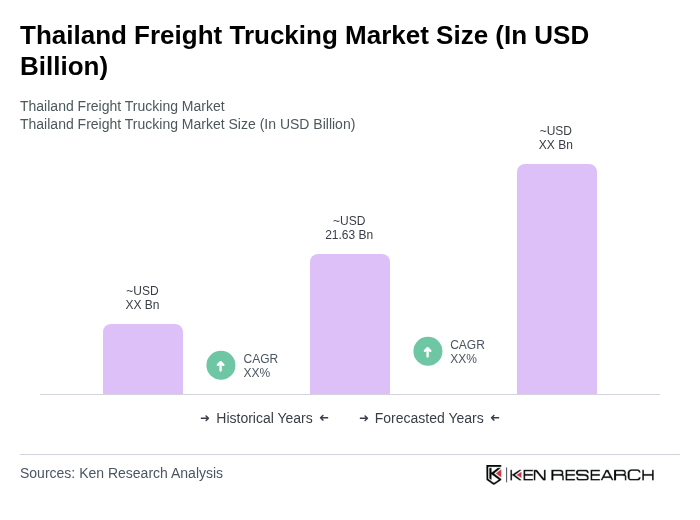
- The Thailand Freight Trucking Market is valued at approximately USD 21.63 billion, based on current market analysis. This growth is primarily driven by the increasing demand for logistics services, fueled by the expansion of e-commerce and manufacturing sectors. The rise in infrastructure development and government initiatives to enhance transportation networks have also significantly contributed to the market's growth. Wholesale and retail trade contributed the largest shipment value at 37.11% in 2024, with long-haul freight securing 73.49% of total value, as national distribution channels stretch from Bangkok to Chiang Mai, Phuket, and border crossings.
- Key regions in this market include Bangkok, Chonburi, and the Eastern Economic Corridor (EEC), which dominate due to their strategic locations and robust industrial activities. Bangkok serves as the economic hub, while Chonburi is vital for its port facilities and Laem Chabang container operations, and the EEC supports integrated manufacturing and agricultural logistics, making these regions critical for freight trucking operations.
- The Thai government has implemented comprehensive transportation regulations to improve freight trucking safety and efficiency standards, mandating advanced vehicle tracking and telematics systems in commercial trucks. These initiatives aim to enhance route efficiency, reduce accidents, and ensure compliance with transportation laws. Digital transformation through technologies like GPS tracking, warehouse automation, and real-time analytics has been accelerating across the sector, thereby improving overall service quality in the freight trucking industry.
Thailand Freight Trucking Market Segmentation
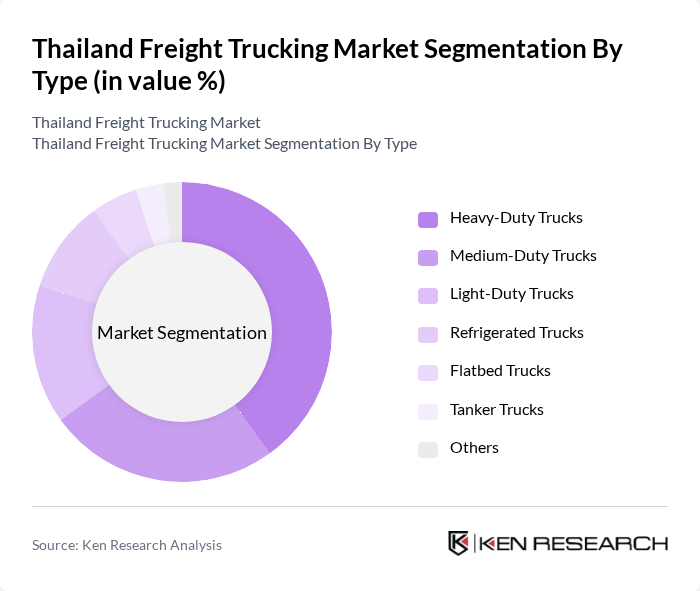
By Type:The freight trucking market can be segmented into various types, including Heavy-Duty Trucks, Medium-Duty Trucks, Light-Duty Trucks, Refrigerated Trucks, Flatbed Trucks, Tanker Trucks, and Others. Each type serves specific transportation needs, with Heavy-Duty Trucks being the most utilized for long-haul freight due to their capacity and durability. Full-truck-load lanes generated 82.38% of value in 2024 as auto parts, electronics, and bulk commodities move in full container or pallet units, while less-than-truck-load services are registering robust growth as parcelized commerce increases.
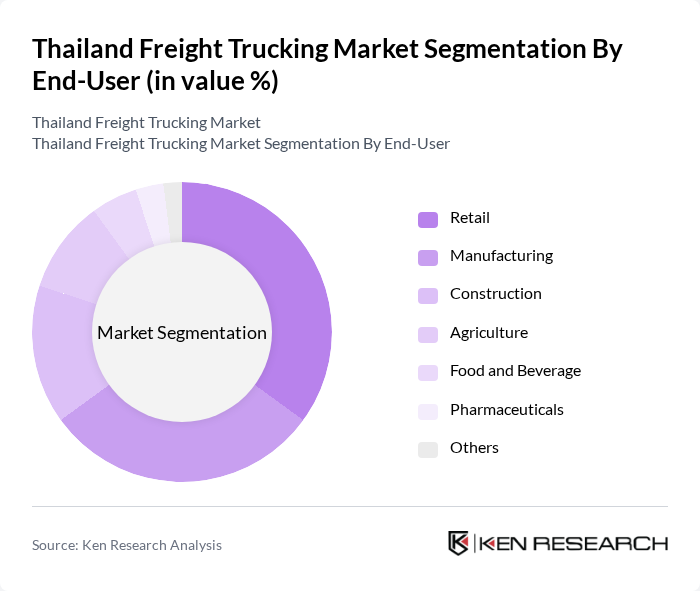
By End-User:The market is also segmented by end-users, including Retail, Manufacturing, Construction, Agriculture, Food and Beverage, Pharmaceuticals, and Others. Wholesale and retail trade is the largest consumer of freight trucking services, driven by the growth of e-commerce and the need for timely deliveries. Rising online penetration, omnichannel store formats, and rapid-replenishment models expand urban and peri-urban delivery runs, with the segment on track for a 6.87% CAGR between 2025-2030.
Thailand Freight Trucking Market Competitive Landscape
The Thailand Freight Trucking Market is characterized by a dynamic mix of regional and international players. Leading participants such as SCG Logistics, Thai Freight Forwarding, Kerry Logistics, JWD Group, TPI Polene Logistics, NCL Logistics, Yusen Logistics, DB Schenker, DHL Supply Chain, Kuehne + Nagel, Agility Logistics, Panalpina, CEVA Logistics, Rhenus Logistics, XPO Logistics contribute to innovation, geographic expansion, and service delivery in this space.
Thailand Freight Trucking Market Industry Analysis
Growth Drivers
- Increasing E-commerce Demand:The Thai e-commerce market is projected to reach approximately THB 3 trillion (USD 90 billion) in future, driven by a surge in online shopping. This growth is expected to increase freight trucking demand significantly, as logistics play a crucial role in fulfilling e-commerce orders. The rise in consumer spending, which is anticipated to grow by 5.5% in future, further supports this trend, creating a robust environment for freight trucking services.
- Infrastructure Development Initiatives:The Thai government has allocated THB 1.5 trillion (USD 45 billion) for infrastructure projects, including road expansions and upgrades, aimed at enhancing logistics efficiency. These initiatives are expected to improve connectivity and reduce transit times, thereby boosting the freight trucking sector. With over 1,000 kilometers of new highways planned in future, the infrastructure improvements will facilitate smoother operations for trucking companies across the country.
- Government Support for Logistics Sector:The Thai government is actively promoting the logistics sector through various policies, including tax incentives and subsidies for green logistics initiatives. In future, the government plans to invest THB 20 billion (USD 600 million) in logistics technology and training programs. This support is expected to enhance operational efficiency and attract foreign investment, further driving growth in the freight trucking market.
Market Challenges
- High Fuel Prices:Fuel prices in Thailand have surged, with diesel prices averaging THB 30 per liter (USD 0.90) in early future. This increase significantly impacts operational costs for trucking companies, squeezing profit margins. The volatility in global oil prices, influenced by geopolitical tensions and supply chain disruptions, poses a persistent challenge for the freight trucking industry, necessitating strategic adjustments by operators to maintain profitability.
- Traffic Congestion in Urban Areas:Major cities in Thailand, such as Bangkok, experience severe traffic congestion, with average speeds dropping to 20 km/h during peak hours. This congestion leads to increased delivery times and operational inefficiencies for freight trucking companies. In future, the estimated economic cost of traffic congestion is projected to reach THB 200 billion (USD 6 billion), highlighting the urgent need for effective traffic management solutions in urban logistics.
Thailand Freight Trucking Market Future Outlook
The Thailand freight trucking market is poised for significant transformation, driven by advancements in technology and a shift towards sustainable practices. As companies increasingly adopt digital solutions for fleet management, operational efficiency is expected to improve. Additionally, the growing emphasis on green logistics will likely lead to the adoption of electric and hybrid vehicles, aligning with global sustainability trends. These developments will create a more resilient and competitive freight trucking landscape in Thailand, catering to evolving consumer demands and regulatory requirements.
Market Opportunities
- Adoption of Green Logistics:The push for environmentally friendly logistics solutions presents a significant opportunity for the freight trucking market. With the government promoting electric vehicles through tax incentives, companies can reduce operational costs while enhancing their sustainability profile. This shift is expected to attract eco-conscious consumers and businesses, driving demand for green logistics services in Thailand.
- Expansion of Cold Chain Logistics:The growing demand for perishable goods, particularly in the food and pharmaceutical sectors, is driving the need for cold chain logistics. The market for cold chain logistics in Thailand is projected to grow to THB 100 billion (USD 3 billion) in future. This expansion offers trucking companies a lucrative opportunity to diversify their services and cater to the increasing need for temperature-controlled transportation.
Scope of the Report
| Segment | Sub-Segments |
|---|---|
| By Type | Heavy-Duty Trucks Medium-Duty Trucks Light-Duty Trucks Refrigerated Trucks Flatbed Trucks Tanker Trucks Others |
| By End-User | Retail Manufacturing Construction Agriculture Food and Beverage Pharmaceuticals Others |
| By Region | Central Region Northern Region Northeastern Region Southern Region |
| By Application | Freight Transportation Logistics and Supply Chain Construction Material Transport Hazardous Material Transport Others |
| By Fleet Size | Small Fleets Medium Fleets Large Fleets Others |
| By Ownership Model | Owned Fleet Leased Fleet Third-Party Logistics Others |
| By Service Type | Full Truck Load (FTL) Less Than Truck Load (LTL) Dedicated Contract Carriage Others |
Key Target Audience
Investors and Venture Capitalist Firms
Government and Regulatory Bodies (e.g., Ministry of Transport, Department of Land Transport)
Logistics and Supply Chain Companies
Freight Forwarders
Fleet Management Service Providers
Transport Equipment Manufacturers
Industry Associations (e.g., Thai Logistics and Transport Association)
Insurance Companies
Players Mentioned in the Report:
SCG Logistics
Thai Freight Forwarding
Kerry Logistics
JWD Group
TPI Polene Logistics
NCL Logistics
Yusen Logistics
DB Schenker
DHL Supply Chain
Kuehne + Nagel
Agility Logistics
Panalpina
CEVA Logistics
Rhenus Logistics
XPO Logistics
Table of Contents
Market Assessment Phase
1. Executive Summary and Approach
2. Thailand Freight Trucking Market Overview
2.1 Key Insights and Strategic Recommendations
2.2 Thailand Freight Trucking Market Overview
2.3 Definition and Scope
2.4 Evolution of Market Ecosystem
2.5 Timeline of Key Regulatory Milestones
2.6 Value Chain & Stakeholder Mapping
2.7 Business Cycle Analysis
2.8 Policy & Incentive Landscape
3. Thailand Freight Trucking Market Analysis
3.1 Growth Drivers
3.1.1 Increasing E-commerce Demand
3.1.2 Infrastructure Development Initiatives
3.1.3 Rising Urbanization
3.1.4 Government Support for Logistics Sector
3.2 Market Challenges
3.2.1 High Fuel Prices
3.2.2 Traffic Congestion in Urban Areas
3.2.3 Regulatory Compliance Costs
3.2.4 Shortage of Skilled Drivers
3.3 Market Opportunities
3.3.1 Adoption of Green Logistics
3.3.2 Technological Advancements in Fleet Management
3.3.3 Expansion of Cold Chain Logistics
3.3.4 Cross-Border Trade Opportunities
3.4 Market Trends
3.4.1 Digital Transformation in Logistics
3.4.2 Shift Towards Sustainable Practices
3.4.3 Increasing Use of Automation
3.4.4 Growth of Last-Mile Delivery Services
3.5 Government Regulation
3.5.1 Emission Standards for Freight Vehicles
3.5.2 Licensing Requirements for Trucking Companies
3.5.3 Road Safety Regulations
3.5.4 Tax Incentives for Green Vehicles
4. SWOT Analysis
5. Stakeholder Analysis
6. Porter's Five Forces Analysis
7. Thailand Freight Trucking Market Market Size, 2019-2024
7.1 By Value
7.2 By Volume
7.3 By Average Selling Price
8. Thailand Freight Trucking Market Segmentation
8.1 By Type
8.1.1 Heavy-Duty Trucks
8.1.2 Medium-Duty Trucks
8.1.3 Light-Duty Trucks
8.1.4 Refrigerated Trucks
8.1.5 Flatbed Trucks
8.1.6 Tanker Trucks
8.1.7 Others
8.2 By End-User
8.2.1 Retail
8.2.2 Manufacturing
8.2.3 Construction
8.2.4 Agriculture
8.2.5 Food and Beverage
8.2.6 Pharmaceuticals
8.2.7 Others
8.3 By Region
8.3.1 Central Region
8.3.2 Northern Region
8.3.3 Northeastern Region
8.3.4 Southern Region
8.4 By Application
8.4.1 Freight Transportation
8.4.2 Logistics and Supply Chain
8.4.3 Construction Material Transport
8.4.4 Hazardous Material Transport
8.4.5 Others
8.5 By Fleet Size
8.5.1 Small Fleets
8.5.2 Medium Fleets
8.5.3 Large Fleets
8.5.4 Others
8.6 By Ownership Model
8.6.1 Owned Fleet
8.6.2 Leased Fleet
8.6.3 Third-Party Logistics
8.6.4 Others
8.7 By Service Type
8.7.1 Full Truck Load (FTL)
8.7.2 Less Than Truck Load (LTL)
8.7.3 Dedicated Contract Carriage
8.7.4 Others
9. Thailand Freight Trucking Market Competitive Analysis
9.1 Market Share of Key Players
9.2 Cross Comparison of Key Players
9.2.1 Company Name
9.2.2 Group Size (Large, Medium, or Small as per industry convention)
9.2.3 Revenue per Mile
9.2.4 Fleet Utilization Rate
9.2.5 On-Time Delivery Rate
9.2.6 Customer Satisfaction Score
9.2.7 Average Load Weight
9.2.8 Pricing Strategy
9.2.9 Cost per Mile
9.2.10 Driver Turnover Rate
9.3 SWOT Analysis of Top Players
9.4 Pricing Analysis
9.5 Detailed Profile of Major Companies
9.5.1 SCG Logistics
9.5.2 Thai Freight Forwarding
9.5.3 Kerry Logistics
9.5.4 JWD Group
9.5.5 TPI Polene Logistics
9.5.6 NCL Logistics
9.5.7 Yusen Logistics
9.5.8 DB Schenker
9.5.9 DHL Supply Chain
9.5.10 Kuehne + Nagel
9.5.11 Agility Logistics
9.5.12 Panalpina
9.5.13 CEVA Logistics
9.5.14 Rhenus Logistics
9.5.15 XPO Logistics
10. Thailand Freight Trucking Market End-User Analysis
10.1 Procurement Behavior of Key Ministries
10.1.1 Budget Allocation Trends
10.1.2 Preferred Freight Services
10.1.3 Contracting Processes
10.1.4 Supplier Evaluation Criteria
10.2 Corporate Spend on Infrastructure & Energy
10.2.1 Investment Trends in Logistics
10.2.2 Infrastructure Development Projects
10.2.3 Energy Efficiency Initiatives
10.2.4 Budgeting for Freight Services
10.3 Pain Point Analysis by End-User Category
10.3.1 Delays in Delivery
10.3.2 Cost Overruns
10.3.3 Quality of Service Issues
10.3.4 Regulatory Compliance Challenges
10.4 User Readiness for Adoption
10.4.1 Technology Adoption Levels
10.4.2 Training and Support Needs
10.4.3 Investment Readiness
10.4.4 Change Management Strategies
10.5 Post-Deployment ROI and Use Case Expansion
10.5.1 Performance Metrics Tracking
10.5.2 Case Studies of Successful Deployments
10.5.3 Scalability of Solutions
10.5.4 Future Investment Plans
11. Thailand Freight Trucking Market Future Size, 2025-2030
11.1 By Value
11.2 By Volume
11.3 By Average Selling Price
Go-To-Market Strategy Phase
1. Whitespace Analysis + Business Model Canvas
1.1 Market Gaps Identification
1.2 Value Proposition Development
1.3 Revenue Streams Analysis
1.4 Cost Structure Evaluation
1.5 Key Partnerships Exploration
1.6 Customer Segmentation
1.7 Channels of Distribution
2. Marketing and Positioning Recommendations
2.1 Branding Strategies
2.2 Product USPs
2.3 Target Market Identification
2.4 Communication Strategies
2.5 Digital Marketing Approaches
2.6 Customer Engagement Tactics
2.7 Performance Metrics
3. Distribution Plan
3.1 Urban Retail Strategies
3.2 Rural NGO Tie-Ups
3.3 Logistics Partnerships
3.4 Distribution Channels Optimization
3.5 Inventory Management Solutions
3.6 Last-Mile Delivery Strategies
3.7 Performance Tracking
4. Channel & Pricing Gaps
4.1 Underserved Routes Analysis
4.2 Pricing Bands Evaluation
4.3 Competitor Pricing Strategies
4.4 Customer Willingness to Pay
4.5 Dynamic Pricing Models
4.6 Price Sensitivity Analysis
4.7 Recommendations for Pricing Adjustments
5. Unmet Demand & Latent Needs
5.1 Category Gaps Identification
5.2 Consumer Segments Analysis
5.3 Emerging Trends Exploration
5.4 Future Demand Projections
5.5 Recommendations for Product Development
5.6 Market Entry Opportunities
5.7 Strategic Partnerships
6. Customer Relationship
6.1 Loyalty Programs Development
6.2 After-Sales Service Strategies
6.3 Customer Feedback Mechanisms
6.4 Relationship Management Tools
6.5 Customer Retention Strategies
6.6 Performance Metrics for Relationships
6.7 Recommendations for Improvement
7. Value Proposition
7.1 Sustainability Initiatives
7.2 Integrated Supply Chains
7.3 Cost-Effectiveness Analysis
7.4 Customer-Centric Approaches
7.5 Competitive Advantage Development
7.6 Value Communication Strategies
7.7 Performance Metrics for Value Proposition
8. Key Activities
8.1 Regulatory Compliance
8.2 Branding Initiatives
8.3 Distribution Setup
8.4 Training and Development Programs
8.5 Performance Monitoring
8.6 Risk Management Strategies
8.7 Recommendations for Key Activities
9. Entry Strategy Evaluation
9.1 Domestic Market Entry Strategy
9.1.1 Product Mix Considerations
9.1.2 Pricing Band Strategies
9.1.3 Packaging Innovations
9.2 Export Entry Strategy
9.2.1 Target Countries Analysis
9.2.2 Compliance Roadmap Development
10. Entry Mode Assessment
10.1 Joint Ventures
10.2 Greenfield Investments
10.3 Mergers & Acquisitions
10.4 Distributor Model Evaluation
10.5 Risk Assessment
10.6 Recommendations for Entry Modes
11. Capital and Timeline Estimation
11.1 Capital Requirements Analysis
11.2 Timelines for Market Entry
11.3 Financial Projections
11.4 Funding Sources Exploration
11.5 Risk Management Strategies
11.6 Recommendations for Capital and Timeline
12. Control vs Risk Trade-Off
12.1 Ownership vs Partnerships Analysis
12.2 Risk Mitigation Strategies
12.3 Recommendations for Control vs Risk
13. Profitability Outlook
13.1 Breakeven Analysis
13.2 Long-Term Sustainability Strategies
13.3 Financial Health Metrics
13.4 Recommendations for Profitability
14. Potential Partner List
14.1 Distributors
14.2 Joint Ventures
14.3 Acquisition Targets
14.4 Strategic Alliances
14.5 Recommendations for Partnerships
15. Execution Roadmap
15.1 Phased Plan for Market Entry
15.1.1 Market Setup
15.1.2 Market Entry
15.1.3 Growth Acceleration
15.1.4 Scale & Stabilize
15.2 Key Activities and Milestones
15.2.1 Milestone Tracking
15.2.2 Performance Metrics
15.2.3 Recommendations for Execution
Research Methodology
Phase 1: Approach1
Desk Research
- Analysis of government reports on transportation and logistics infrastructure in Thailand
- Review of industry publications and market reports specific to the freight trucking sector
- Examination of trade statistics and import/export data relevant to freight trucking
Primary Research
- Interviews with fleet managers and logistics coordinators from major trucking companies
- Surveys targeting small to medium-sized trucking operators to gather operational insights
- Field interviews with regulatory bodies and transport authorities to understand compliance issues
Validation & Triangulation
- Cross-validation of data through multiple sources including industry reports and expert opinions
- Triangulation of findings from primary interviews with secondary data trends
- Sanity checks conducted through expert panel reviews to ensure data reliability
Phase 2: Market Size Estimation1
Top-down Assessment
- Estimation of total logistics spending in Thailand as a basis for freight trucking market size
- Segmentation of the market by freight type, including FTL (Full Truck Load) and LTL (Less Than Truck Load)
- Incorporation of government initiatives aimed at improving transportation efficiency
Bottom-up Modeling
- Collection of operational data from leading trucking firms to establish volume benchmarks
- Cost analysis based on fuel prices, labor costs, and maintenance expenses
- Calculation of revenue potential based on average freight rates and service frequency
Forecasting & Scenario Analysis
- Utilization of historical growth rates to project future market trends through 2030
- Scenario modeling based on economic indicators and regulatory changes affecting the trucking industry
- Development of best-case, worst-case, and most-likely scenarios for market growth
Phase 3: CATI Sample Composition1
| Scope Item/Segment | Sample Size | Target Respondent Profiles |
|---|---|---|
| Long-Haul Freight Operations | 45 | Fleet Managers, Operations Directors |
| Regional Distribution Services | 40 | Logistics Coordinators, Supply Chain Managers |
| Cold Chain Logistics | 35 | Warehouse Managers, Quality Control Officers |
| Construction Material Transport | 38 | Project Managers, Procurement Specialists |
| Last-Mile Delivery Services | 42 | Delivery Managers, Customer Service Representatives |
Frequently Asked Questions
What is the current value of the Thailand Freight Trucking Market?
The Thailand Freight Trucking Market is valued at approximately USD 21.63 billion. This growth is driven by increasing logistics demand, particularly from the e-commerce and manufacturing sectors, alongside government initiatives to enhance transportation infrastructure.
What are the key regions for freight trucking in Thailand?
What types of trucks are commonly used in Thailand's freight trucking market?
How does e-commerce impact the Thailand Freight Trucking Market?
Other Regional/Country Reports
Other Adjacent Reports
Vietnam Telematics Market
Canada Fleet Management Market Size, Share & Forecast, By Solution Type, Deployment Model & End-Use Industry, 2025-2032Indonesia Heavy-Duty Truck Market
South Africa Infrastructure Development Market
Why Buy From Us?

What makes us stand out is that our consultants follow Robust, Refine and Result (RRR) methodology. Robust for clear definitions, approaches and sanity checking, Refine for differentiating respondents' facts and opinions, and Result for presenting data with story.

We have set a benchmark in the industry by offering our clients with syndicated and customized market research reports featuring coverage of entire market as well as meticulous research and analyst insights.

While we don't replace traditional research, we flip the method upside down. Our dual approach of Top Bottom & Bottom Top ensures quality deliverable by not just verifying company fundamentals but also looking at the sector and macroeconomic factors.

With one step in the future, our research team constantly tries to show you the bigger picture. We help with some of the tough questions you may encounter along the way: How is the industry positioned? Best marketing channel? KPI's of competitors? By aligning every element, we help maximize success.

Our report gives you instant access to the answers and sources that other companies might choose to hide. We elaborate each steps of research methodology we have used and showcase you the sample size to earn your trust.

If you need any support, we are here! We pride ourselves on universe strength, data quality, and quick, friendly, and professional service.